
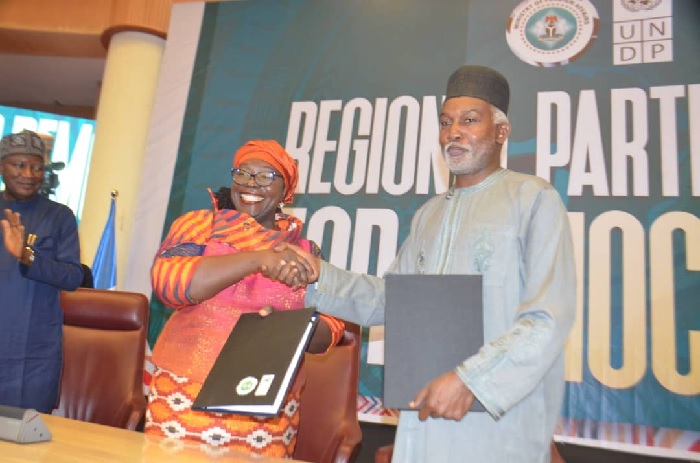
Nigerian Foreign Minister has stressed the need for Africa to build a future in which democracy in the continent was not imposed nor borrowed, but authentically owned, culturally grounded and enduringly strong in tune with local peculiarities.
Tuggar who made this known Monday at the official signing ceremony of the Regional Partnership for Democracy (RPD) between Nigeria and United Nations Development Programme (UNDP) with the aim of strengthening democratic governance across West Africa through inclusive regional growth said the event was not merely the launch of a programme, but the opening of a new chapter in Africa’s democratic journey.
Tuggar said RPD was conceived in direct response to circumstances that surrounds democracy in the region noting that it rests on a simple, yet powerful proposition that democracy flourishes most sustainably when rooted in African values and attuned to local peculiarities, whilst drawing judiciously from global best practices.
According to Tuggar, “It is in direct response to these circumstances that the Regional Partnership for Democracy (RPD) was conceived. The RPD rests on a simple, yet powerful proposition: that democracy flourishes most sustainably when it is rooted in African values and attuned to local peculiarities, whilst drawing judiciously from global best practices.
“Such carefully calibrated synthesis is indispensable, if democracy is to enjoy genuine ownership, legitimacy, and long-term durability among our people. The variable geometry of democracy, its different forms and speeds need to be taken into account” he said.
Continuing, Tuggar said the RPD was more than a policy instrument, but President Tinubu’s contribution and indeed, Nigeria’s gift to strengthening and flourishing of democracy in Africa.
He said the RPD seeks not only to strengthen electoral institutions, deploy early-warning and rapid-response mechanisms against unconstitutional transitions, but also, elevate youth and civil society as indispensable democratic actors, counter disinformation and lay the foundations for long-term governance stability.
He noted that while Nigeria and the United Nations Office in Abuja were signatories to the instrument, the RPD was open to co-ownership by all.
He informed that it was a regional public good, intended not solely for ECOWAS Member States, but for all West African nations, reflecting the simple truth that African values neither begin nor end at the boundaries of ECOWAS or the AES.
He expressed optimism that as its impact becomes manifest, that other African regions seeking sustainable, African-rooted democratic models will join this initiative.
“To our development partners, to all friends of Africa and to all who believe deeply in the promise of this continent, we extend an invitation to support this bold undertaking. The RPD offers a credible, politically viable and technically sound platform for reversing democratic backsliding and restoring institutional legitimacy.
“It is a home-grown, yet globally informed, mechanism. Simply, an African solution to an African challenge! Ladies and gentlemen, democracy exists on the assumption that there is a loose consensus of what truth or facts are” he noted.
UNDP Resident Representative for Nigeria, Ms. Elsie Attafuah, said the RPD was a milestone Africa-led initiative, saying it “embodies Nigeria’s continental leadership” and reflects the UN’s commitment to supporting governments that seek homegrown democratic solutions.
Her words, “This initiative is African-led, regionally anchored and globally significant. It is grounded in our belief that the answers to Africa’s governance challenges lie within Africa itself.”
She thanked President Tinubu for championing democracy and dialogue during his tenure as ECOWAS Chair and commended Amb. Tuggar for “translating that legacy into a regional framework that now stands ready to take flight.”
She listed the RPD’s four pillars: strengthening democratic institutions, broadening inclusive citizen participation, ensuring credible electoral systems, and enhancing regional cooperation.
“The signing we witnessed today is not a conclusion but a beginning,” she added. “This is a movement to build public trust, reaffirm constitutionalism and make democracy deliver tangible benefits to our citizens.”
She assured that UNDP and other UN agencies would work with governments, civil society and development partners to mobilise funding, technical expertise and implementation support across West Africa.
“Our shared aspiration is a West Africa where democracy delivers peace, prosperity and dignity,” Attafuah said.
Also speaking, Senior Special Assistant to the President on Foreign Affairs & International Relations, Amb Sola Enikanolaye while assuring that Nigeria would not disappoint Africa in terms of providing strong leadership, informed of President Tinubu’s unwavering support for the initiative, stating that his presence at the event was a clear testament to the President’s commitment to seeing it succeed.
His words, “The President’s backing is unequivocal, and we will continue to drive this agenda forward with renewed vigor and dedication,” Ambassador Enikanolaiye affirmed, urging all stakeholders to rally behind the effort.


more recommended stories
 FG, experts unite to tackle malnutrition with new National Plan
Nigeria has drawn a bold line.
-
National security remains Tinubu’s top priority – FG
Nigerian government has reiterated its commitment.
-
AKH-TRACADA commends Cross River Govt for creating Anti-Drug Club in schools
Anti – kidnapping, Human Trafficking, Child.
-
China, Africa intelligentsia share thoughts on harnessing GGI potentials
Chinese and African intelligentsia have shared.
-
Establishment of 15 Chinese Corners highlights China, Nigeria relations – Education Secretary
FCT Mandate Secretary for Education, Dr..
-
Chinese Mandarin officially added to Nigerian school curriculum
Nigerian government has formally added the.
-
Climate Change: Tinubu calls for resilient, green inclusive industrial future
Nigerian President, Bola Ahmed Tinubu has.
-
AKH-TRACADA commiserates with Republic of Ghana over death of two ministers, other top officials
The Anti – kidnapping, Human Trafficking,.
-
AKH-TRACADA hails FG for compulsory NDLEA Integrity Drug Test for undergraduates
An NGO in the forefront of.
-
FCT Health Official urges supportive workplaces for breastfeeding mothers
The Deputy Director of Nutrition, Federal.






Leave a Comment