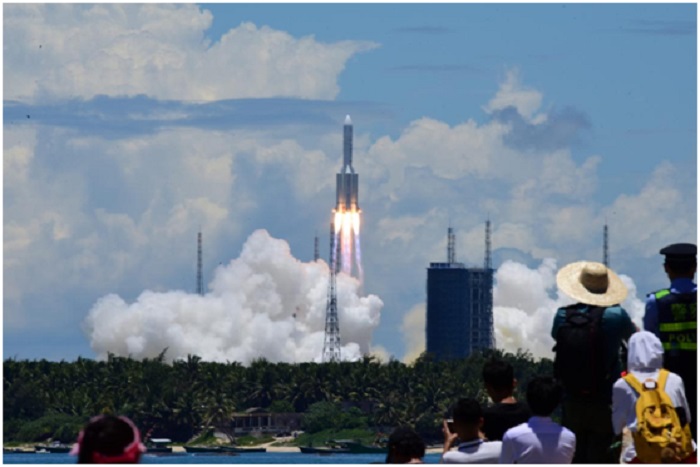
Photo taken on July 23, 2020, shows people watching China’s Tianwen-1 Mars probe being launched from Wenchang Spacecraft Launch Site in south China’s Hainan province. (Photo by Meng Zhongde/People’s Daily Online)

China plans to conduct more than 40 space launches in 2021, with the construction of the country’s first space station as its top priority, leading domestic rocket contractor China Aerospace Science and Technology Corp (CASC) said on Wednesday.
In the 2020 Blue Book of China Aerospace Science and Technology Activities issued at a press conference on Wednesday, CASC said parts of the space station, including the Tianhe core cabinet, the Tianzhou-2 and -3 cargo spaceships, and the Shenzhou-12 and -13 manned spacecraft, will be sent into space in 2021.
Another seven commercial launches are planned, which will be open to market users wishing to send micro-sized and small satellites into space, the Blue Book said.
China carried out 39 launches in 2020, sending 89 spacecraft into space and breaking the record for total weight at 103.06 tons, a 29.3-percent increase from the previous year.
China’s number of space launches and weight of payloads in 2020 both ranked second in the world after the US, marking major strides forward in China’s space exploration, the Blue Book said.
Rounding up the year’s aerospace developments, China made remarkable achievements in a number of cutting-edge technologies and major breakthroughs in space missions, it said.
China’s latest state-of-the-art carrier rocket, the Long March-5B, made a successful maiden flight in May, sending the assembly of a trial version of the next-generation manned spaceship with a test cargo-returning spacecraft into planned orbit.
The trial run opened the official chapter of China’s space station construction, which “lays a solid foundation for a future manned landing on the Moon,” said the Blue Book.
During the experimental flight, China conducted a series of space experiments such as its first attempt of in-orbit 3D printing, which aimed to study the feasibility of “self-made” manufacturing in space to address the problem of long supply lines during exploration missions.
Even more thrilling for space fans over the world, China embarked on voyages to the moon and Mars in 2020, suggesting China’s growing confidence in the field after years of unremitting efforts.
The country’s first Mars exploration project, Tianwen-1, which has a triple mission of orbiting, landing and roving in one flight, embarked on a journey to the Red Planet on July 23, 2020.
After flying in space for 215 days, which took it some 212 million kilometers from Earth, it successfully entered the Martian orbit on Wednesday and will remain there for another three months, with all payloads powered on for scientific study, before eventually touching down, China’s National Space Administration said in a statement sent to the Global Times.
China’s first lunar sample-retrieval mission, Chang’e-5, concluded its journey on December 17, 2020 after a 23-day adventure to the neighboring celestial body, bringing back with it 1,731 grams of lunar soils, and making China the third country to have successfully brought lunar samples back to Earth after the US and the former Soviet Union.
As one of the most complex and challenging tasks in the country’s aerospace history, Chang’e-5 achieved multiple firsts, including the first-ever takeoff from the lunar surface, and the first rendezvous and docking in the lunar orbit.
Impressive as the achievements are, Chinese space analysts note that there remain some technological gaps in the field compared with the US. Song Zhongping, an aerospace expert and TV commentator, told the Global Times on Wednesday that the US is still the leading force in the global space exploration race.
“Beginning in the 1960s, the US got a head start. Thanks to a relatively strong scientific base that laid the groundwork for aerospace development, the US has formed a more mature, balanced mode with NASA leading the national space programs and Elon Musk spearheading the drive in commercial areas of the aerospace industry.”
However, he noted that China has developed its own path, different from the US. “We drew the blueprint for future space missions as a whole and then divided it into parts, which will be realized step by step in a steady manner.”
Song illustrated this idea using the examples of China’s BeiDou Navigation Satellite System, deep-space exploration, and manned missions.
Despite the ravaging pandemic that struck the world last year, China not only kept its head high and made steady strides in its own space missions, but it also engaged in multiple space cooperation projects with countries including Argentina, Ethiopia, Egypt and other countries along the Belt and Road routes.
Various types of cooperation were involved, such as satellite exports, cooperative research and development, satellite launches, and application services.
Source: Global Times


 AKH-TRACADA demands Justice, protection for abused Abia child, commends police
Anti-Kidnapping, Human Trafficking, Child Abuse and.
 AKH-TRACADA rejects campaign to pressure U.S. to release Tinubu’s FBI records, wants court to decide
Anti-Kidnapping, Human Trafficking, Child Abuse and.
 Nigeria celebrates Chinese cuisines at food festival
Nigeria has celebrated Chinese cuisines of.
 2027: Elumelu Campaign Group sets to meet party executives, leaders
In a bid to strategize for.
 AKH-TRACADA congratulates Marwa on reappointment as NDLEA Chair
The Executive and members of the.
 Road Safety is a collective responsibility, says FCT DRTS Ag Director
The Acting Director, FCT Directorate of.
 Igbo group calls on Tinubu to release IPoB leader, Kanu
President Bola Ahmed Tinubu has been.
Ministerial slot: Tinubu appoints Nnaji’s replacementBarely a month after resignation of.
 Lawyer cautions Kanu against dragging Buratai into his trial
An Abuja based Legal Practitioner, Osuagwu.
Odey commends Tinubu for appointing Amupitan INEC chairConvener of Equitable Remedy, Mrs. Magaret.
Leave a Comment