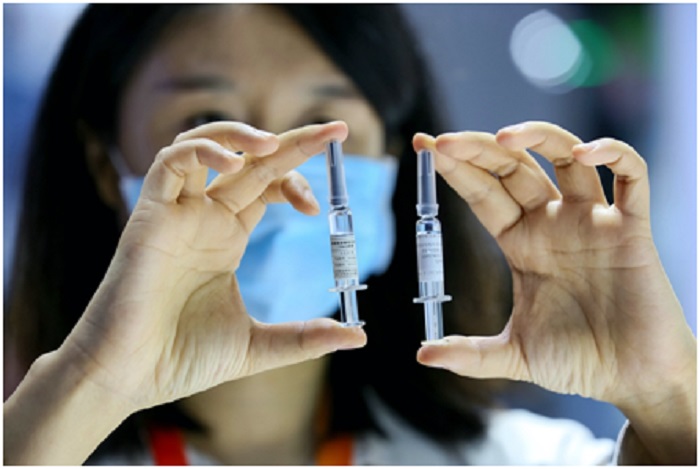
Staff members shows the coronavirus vaccine by the China National Biotec Group at the The China International Fair for Trade in Services (CIFTIS) held in Beijing on September 7. Photo by Luo Wei/People’s Daily Online

COVID-19 vaccine cooperation is expected to be the focus of the BRICS summit, observers said, noting that against the backdrop of COVID-19, cooperation on the vaccines has become the highlight of China’s diplomacy this year, which offers a glimmer of hope for the world, and further reflects China’s commitment to “build a community with a shared future for mankind.”
Chinese President Xi Jinping will attend the 12th BRICS summit on Tuesday at the invitation of Russian President Vladimir Putin, Foreign Ministry spokesperson Hua Chunying announced on Thursday.
Alexey Rogachev, political counselor of the Russian Embassy in China, said on Monday at a media briefing on the Russian BRICS Chairmanship in 2020 that public healthcare is an important issue under the BRICS framework.
Rogachev said there were discussions on the cooperation against the pandemic, and an understanding of the need for enhancing cooperation on healthcare and economic recovery amid the pandemic.
China and Russia have made some progress in vaccine development and have begun to experiment in epidemic prevention practices, experts said.
Although the target markets of vaccines developed in China and Russia are not the same, there’s much room left for cooperation between the two countries. For instance, China could help Russia manufacture their vaccines, Tao Lina, a Shanghai-based vaccine expert, told the Global Times.
Chinese company Sinovac Biotech and Brazil’s Butantan Institute are also closely working on COVID-19 vaccine development.
Song Kui, president of the Contemporary China-Russia Regional Economy Research Institute, told the Global Times that at the BRICS summit, the member states will sign agreements related to vaccine cooperation, which will contribute to regional and global efforts.
Chinese Ambassador to Russia Zhang Hanhui said that China hopes to work with Russia to effectively advance cooperation in vaccine research and development under the framework of the China-Russia Year of Scientific and Technological Innovation to jointly launch public health products, and provide safety for the lives of the two people, Guangming Daily reported on Monday.
Zhang noted that Chinese and Russian pharmaceutical companies and scientific research teams are actively communicating on the joint clinical trials of the vaccines.
COVID-19 vaccine cooperation has run through China’s diplomacy calendar this year, from Latin American to Southeast Asian countries, and deals have been signed that have helped create what Chinese observers hailed as “the most favorable diplomatic situation for China,” and that have reflected China’s proposal of “building a community with a shared future for mankind.”
Chinese Premier Li Keqiang spoke at the 23rd China-ASEAN leaders’ meeting on Thursday, saying that “China will actively consider ASEAN countries’ requirements for COVID-19 vaccines, and take practical steps to promote the availability and affordability of the vaccine.”
Tao noted that the safety of China’s vaccine would contribute to its popularity in the world.
Sinopharm Chairman Liu Jingzhen said at a conference in early November that some 100,000 people have been vaccinated with the company’s vaccine, and they have shown no adverse reactions so far. Among those who were inoculated and traveled aboard, none have been infected with the virus, Liu said.
Tao said the vaccine China pushed abroad is an “inactivated vaccine,” which means the vaccine was produced after killing the virus. The technology is relatively mature, and is unlikely to trigger an adverse reaction, he added.
The vaccine expert also predicted China will donate vaccines to poverty-stricken countries, and treat vaccines as public goods of technological transfer to countries which have the ability to produce a vaccine but would cooperate with China.
Despite China’s contributions on vaccine R&D, its cooperation with other countries has been smeared by certain Western media as “vaccine diplomacy.” They said China is using the vaccine to lure countries to accept certain diplomatic terms.
Chinese observers said China has committed itself in this highly needed global cooperation in the face of common challenges, as it is fulfilling its commitment as a responsible major power, instead of using the vaccine to satisfy its own purposes.
The US is also a bellwether of vaccine development, yet it is reluctant to conduct cooperation on this field. China will fill the void the US has left, which helps to narrow the gap of vaccine accessibility between developed and developing countries, Tao said.
Source: Global Times


 2027: Elumelu Campaign Group sets to meet party executives, leaders
In a bid to strategize for.
 AKH-TRACADA congratulates Marwa on reappointment as NDLEA Chair
The Executive and members of the.
 Road Safety is a collective responsibility, says FCT DRTS Ag Director
The Acting Director, FCT Directorate of.
 Igbo group calls on Tinubu to release IPoB leader, Kanu
President Bola Ahmed Tinubu has been.
 Ministerial slot: Tinubu appoints Nnaji’s replacement
Barely a month after resignation of.
 Lawyer cautions Kanu against dragging Buratai into his trial
An Abuja based Legal Practitioner, Osuagwu.
Odey commends Tinubu for appointing Amupitan INEC chairConvener of Equitable Remedy, Mrs. Magaret.
 FCT waste disposal contractors notify of planned suspension of services over nine months debt
Contractors handling the contract for city.
 FG begins evacuation of stranded Nigerians in Central African Republic
Nigerian government may have concluded plans.
 DICAN hosts int’l conference, harps on global peace, security, dev’t
The Diplomatic Correspondents Association of Nigeria.
Leave a Comment