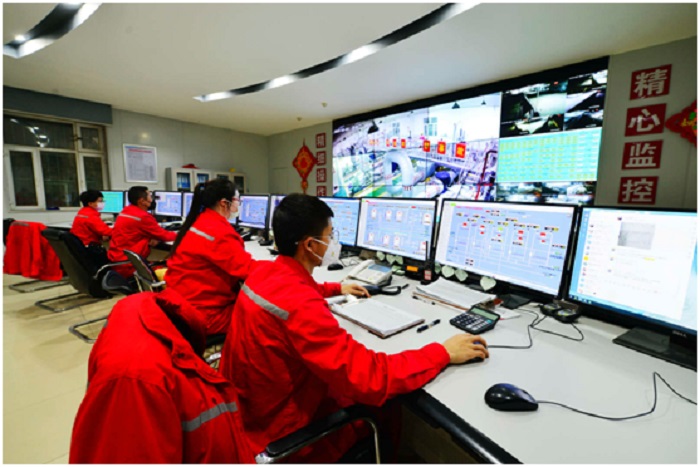
Workers remotely monitor the production process at a production base of China Petrochemical Corporation in Aksu City, Northwest China’s Xinjiang Uygur Autonomous Region, March 3. Photo by Shi Libin/People’s Daily

China has seen rapid growth in its telecommuting industry this year due to requirements put in place to curb the COVID-19 epidemic and robust development in the country’s digital economy.
According to statistics, the value of the telecommuting market is expected to reach 44.8 billion yuan this year, about 7.5 times its size in 2017.
“During the epidemic, people marveled at the power of digital technologies,” said Chen Hang, CEO of DingTalk, the telecommuting tool developed by e-commerce giant Alibaba, adding that the remote working mode was widely adopted at least three years ahead of schedule.
The platform has drawn 300 million individual users and more than 15 million corporate clients. Most notably, over 10 million companies joined it after the epidemic began. It also deployed more than 100,000 new cloud servers in Alibaba Cloud, the cloud computing arm of Alibaba, to support online classes for 130 million students.
Like Alibaba, other Chinese internet giants including ByteDance and Tencent have also offered multi-functional and reliable telecommuting tools.
“Working from home saves me two hours in commuting each day, so I hope that this will become a regular option,” said Ma Chen, an employee of a state-owned enterprise in Beijing, adding that the company allowed employees to work remotely for several months after the Lunar New Year holiday.
Experts said that there will be broad prospects for telecommuting in the post-epidemic era. According to Chen, telecommuting can help micro and small firms and startups significantly reduce operations costs, adding that the integration of online and offline channels could become a new trend in the future.
While the Chinese government encourages the sector’s development, new technologies including 5G, artificial intelligence and blockchain will make telecommuting more efficient.
5G will play a vital role in the sector in the foreseeable future. Technologies such as augmented reality or virtual reality could be used for telecommuting and video conferences, according to Liu Xiangdong, deputy head of the economic research department of the China Center for International Economic Exchange.
“This requires a wireless communication network with high stability and high-speed connectivity, and 5G can meet that requirement,” Liu added.
Source: People’s Daily Online


 AKH-TRACADA demands Justice, protection for abused Abia child, commends police
Anti-Kidnapping, Human Trafficking, Child Abuse and.
 AKH-TRACADA rejects campaign to pressure U.S. to release Tinubu’s FBI records, wants court to decide
Anti-Kidnapping, Human Trafficking, Child Abuse and.
 Nigeria celebrates Chinese cuisines at food festival
Nigeria has celebrated Chinese cuisines of.
 2027: Elumelu Campaign Group sets to meet party executives, leaders
In a bid to strategize for.
 AKH-TRACADA congratulates Marwa on reappointment as NDLEA Chair
The Executive and members of the.
 Road Safety is a collective responsibility, says FCT DRTS Ag Director
The Acting Director, FCT Directorate of.
 Igbo group calls on Tinubu to release IPoB leader, Kanu
President Bola Ahmed Tinubu has been.
Ministerial slot: Tinubu appoints Nnaji’s replacementBarely a month after resignation of.
 Lawyer cautions Kanu against dragging Buratai into his trial
An Abuja based Legal Practitioner, Osuagwu.
Odey commends Tinubu for appointing Amupitan INEC chairConvener of Equitable Remedy, Mrs. Magaret.
Leave a Comment