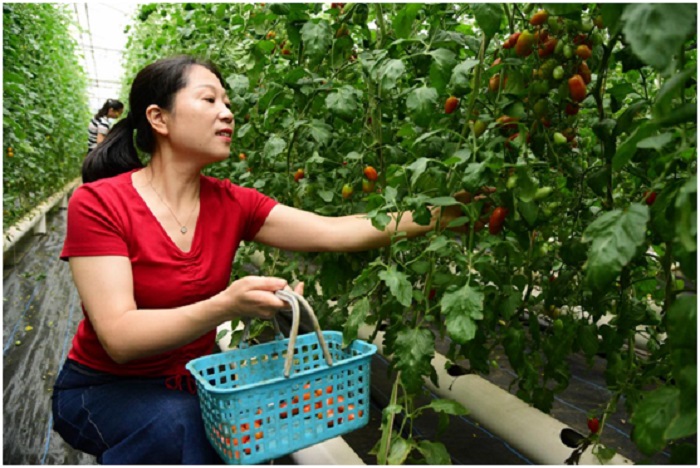
A woman picks tomatoes grown with soilless culture method in Zhenjiang, east China's Jiangsu province, June 16, 2020. (Photo by Shi Yucheng/People's Daily Online)

Tomatoes are planted on shelves hanging a meter or so above the ground and winding up in a digital greenhouse run by Xingang, an agricultural tech firm in Zhenjiang Economic & Technical Development Zone of east China’s Jiangsu province.
“By hanging the plants above the ground, we not only save space, but also make sure that every tomato here is evenly exposed to the sunshine,” said Wang Mingjing, head of the company’s general office.
Zhenjiang’s temperature has fallen below zero degree Celsius in January, but the digital greenhouse was kept at 25 degrees Celsius by an intelligent management system and modern facilities. Technical director of the company Lu Lian told People’s Daily that the intelligent system has made planting much smarter.
“We can monitor and control the temperature, humidity and illumination in the greenhouse remotely, so that the indoor environment is always warm despite the changes outside,” he said.
An injector-like tube is stuck into the growth medium of every tomato plant to feed the plant water and nutrition, which also irrigates the plant by drip feed. According to Lu, the nutrient solution is automatically prepared by smart equipment in the greenhouse based on the growth of the plants and illumination.
The growth period of the plants is around 9 months, and each of the plant yields about 15 kilograms of tomatoes each year, which means the plants’ economic profit is three to four times of traditional ones.
Wang told People’s Daily that the tomatoes are pesticide-free, as the soilless culture prevents soil borne diseases and also filters irrigation water for a second time, which lowers the occurrence of diseases from the source and thus ensures food safety. Besides, each of the tomato has a QR code that shows its growth information and examining reports, Wang added.
The high-efficient agricultural philosophy is not limited to planting, but extending to every link of crop production. In recent years, Zhenjiang Economic & Technical Development Zone has vigorously developed modern agricultural facilities and nurtured a batch of emerging entities. Smart greenhouses, frost prevention machines, precise planting systems, water and fertilizer all-in-one machines, as well as automatic spraying and dripping system are widely adopted.
By the end of 2020, Zhenjiang has 527,000 mu (35,133 hectares) of agricultural facilities, accounting for 24.2% of its total farming area. A total of 43,719 greenhouses were built, covering 45,015 mu of land.
Li Chuande, deputy director of Zhenjiang’s bureau of agriculture and rural affairs, noted that the city will develop high-efficient agriculture, advance agricultural mechanization, and establish demonstration zones of environmental friendly management, so as to bring more green and healthy food to customers and tangible benefits to farmers.


 2027: Elumelu Campaign Group sets to meet party executives, leaders
In a bid to strategize for.
 AKH-TRACADA congratulates Marwa on reappointment as NDLEA Chair
The Executive and members of the.
 Road Safety is a collective responsibility, says FCT DRTS Ag Director
The Acting Director, FCT Directorate of.
 Igbo group calls on Tinubu to release IPoB leader, Kanu
President Bola Ahmed Tinubu has been.
 Ministerial slot: Tinubu appoints Nnaji’s replacement
Barely a month after resignation of.
 Lawyer cautions Kanu against dragging Buratai into his trial
An Abuja based Legal Practitioner, Osuagwu.
Odey commends Tinubu for appointing Amupitan INEC chairConvener of Equitable Remedy, Mrs. Magaret.
 FCT waste disposal contractors notify of planned suspension of services over nine months debt
Contractors handling the contract for city.
 FG begins evacuation of stranded Nigerians in Central African Republic
Nigerian government may have concluded plans.
 DICAN hosts int’l conference, harps on global peace, security, dev’t
The Diplomatic Correspondents Association of Nigeria.
Leave a Comment