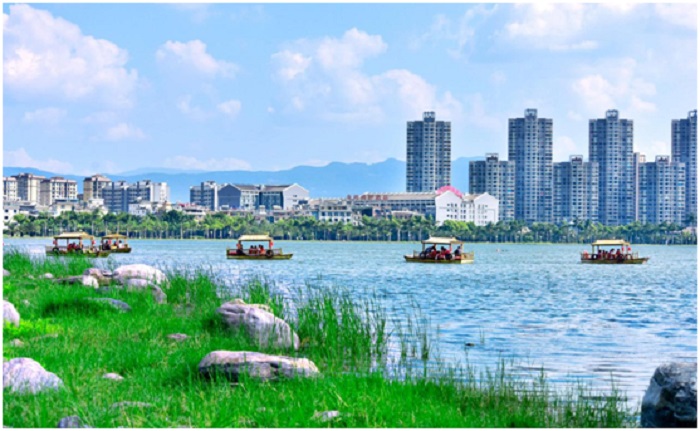
Tourists are boating on the lake of an ecological park in Mile, Honghe Hani and Yi autonomous prefecture, southwest China's Yunnan province, Oct. 5, 2021. (Photo by Pu Jiayong/People's Daily Online)

Southwest China’s Yunnan province has achieved significant progress in biodiversity conservation over the recent years.
It has artificially bred the first filial generation of green peafowls and the third of black snub-nosed monkeys.
The Germplasm Bank of Wild Species, the world’s second-biggest and Asia’s largest wildlife germplasm bank, is currently located in the province. It promulgated the new concept of plant species with extremely small populations and implemented a full-coverage native plants conservation plan. So far, the province has completed an evaluation and field investigation for nearly 2/3 of China’s native plants.
Wang Lisong is a researcher with the Kunming Institute of Botany (KIB), Chinese Academy of Science. Sunburns and mosquito bites are a daily routine of his work when trekking in the wild. Spending over six months each year collecting samples in the field, he has discovered 36 new lichen species, completed over 8,200 relevant documents, and studied more than 2,000 lichen species. What he has accomplished has created the groundwork for China’s largest lichen resource bank.
In 2017, the KIB, in collaboration with Chinese and foreign scientific research teams, discovered and named a new hylobatidae species – the Hoolock tianxing. According to an official document recording the new species found in Yunnan between 1992 and 2020, the province has spotted 3,718 new species during the period, including 2,519 new species and 1,199 newly recorded species.
Due to severe illnesses, including suppuration of the umbilical cord, a newborn baby elephant in Yunnan’s Xishuangbanna Dai autonomous prefecture was abandoned by its herd barely six days after its birth on August 28. The Asian Elephant Breeding and Rescue Center at Xishuangbanna National Nature Reserve later rescued the cub.
Since its inception in 2008, the facility has rescued 24 wild Asian elephants. Furthermore, nine elephants were bred there, and they all survived.
Thanks to years of efforts and exploration, the population of multiple rare and endangered wild animals have been on a stable recovery, including the Asian elephant, black snub-nosed, monkey and black-crested gibbon.
The Germplasm Bank of Wild Species, established in 2007 by the KIB, had preserved 85,046 plant seeds of 10,601 species as of December the last year, which accounted for 36 percent of the number of flowering plant species in China.
The Germplasm Bank of Wild Species and the KIB, relying on their national key laboratories, systematically studied the chemical composition of 1,271 plants from 589 genera under 201 families and released information of over 10,000 natural products. A large batch of medicines made with plant extractions have been launched, and the labs have gradually grown into global research leaders in phytochemistry.


 AKH-TRACADA rejects campaign to pressure U.S. to release Tinubu’s FBI records, wants court to decide
Anti-Kidnapping, Human Trafficking, Child Abuse and.
 Nigeria celebrates Chinese cuisines at food festival
Nigeria has celebrated Chinese cuisines of.
 2027: Elumelu Campaign Group sets to meet party executives, leaders
In a bid to strategize for.
 AKH-TRACADA congratulates Marwa on reappointment as NDLEA Chair
The Executive and members of the.
 Road Safety is a collective responsibility, says FCT DRTS Ag Director
The Acting Director, FCT Directorate of.
 Igbo group calls on Tinubu to release IPoB leader, Kanu
President Bola Ahmed Tinubu has been.
Ministerial slot: Tinubu appoints Nnaji’s replacementBarely a month after resignation of.
 Lawyer cautions Kanu against dragging Buratai into his trial
An Abuja based Legal Practitioner, Osuagwu.
Odey commends Tinubu for appointing Amupitan INEC chairConvener of Equitable Remedy, Mrs. Magaret.
 FCT waste disposal contractors notify of planned suspension of services over nine months debt
Contractors handling the contract for city.
Leave a Comment