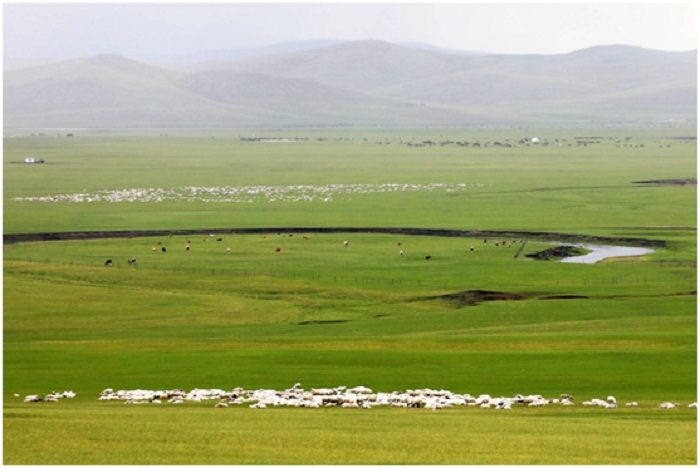
Photo taken on Aug. 5 shows a magnificent view of the Mo'ergele River running across the Hulun Buir Grasslands in North China's Inner Mongolia Autonomous Region. Photo by Han Yingqun/People's Daily Online

Manglai village in New Barag Right Banner, Hulun Buir, North China’s Inner Mongolia Autonomous Region, has found an effective way to shake off poverty, striking a balance between local husbandry development and ecological conservation.
The grassland there is glimmering in the summer, where fences have been demolished; and cattle and sheep are browsing in vast meadows where green leaves swaying in the wind.
The once impoverished village is now a pioneer in modernized pasture construction. This remarkable transition could not have been achieved without the efforts of Migej Dolge, Party head of Manglai village.
“The separate operation in the past failed to control cost and expenses, so the incomes of the herdsmen were low,” Migej Dolge introduced. After repeated discussion and research, he and other village officials finally came up with a clear solution – to establish a professional sheep breeding cooperative. They centralized 18 households’ livestock and pasture based on the principle of free will and distributed the resource to realize large-scale, intensive and professional operation of the cooperative. Four years after the cooperative was established, the 18 households saw a growth of nearly 10,000 yuan ($1,437) in their annual average income.
The cooperative introduced a rotational paddock grazing system, which brought benefits and further spurred the enthusiasm for the herdsmen. Under the guidance of Migej Dolge, New Barag Right Banner established its first joint-stock professional cooperative in June 2019 which integrates 26,000 hectares of pasture and 5,800 cattle and sheep. Its members include 248 herdsmen from 88 households.
Keeping a balance between forage and livestock, the joint-stock cooperative made rotational paddock grazing plans, demolished fences on the grassland, and demarcated rotational grazing pastures and cutting pastures. It secures sustained and healthy development of the husbandry industry while guaranteeing the ecological balance of the pastures.
Villager Aladengtsang’s family was once a registered impoverished household. After joining the joint-stock cooperative, he entrusted his 180 sheep to it. He told the People’s Daily that he earned a net income of 110,000 yuan last year, which enabled him to pay off his loans and lifted him out of poverty. “The cooperative is great, and I’ll keep working for it,” he said.
The joint-stock cooperative has largely lowered the production cost for herdsmen, expanded their employment channels and improved their living quality. “We have benefited enormously by exploiting the pastures in a science-based manner,” Migej Dolge told the People’s Daily.
Since the 18th National Congress of the Communist Party of China in 2012, Inner Mongolia Autonomous Region has applied grazing ban and forage-livestock balance mechanism to 68 million hectares of grassland. It has also been planting one million hectares of grassland on average each year. The vegetation coverage ratio of grasslands of the autonomous region reached 44 percent last year, up 4 percentage points from that in 2012.


 AKH-TRACADA demands Justice, protection for abused Abia child, commends police
Anti-Kidnapping, Human Trafficking, Child Abuse and.
 AKH-TRACADA rejects campaign to pressure U.S. to release Tinubu’s FBI records, wants court to decide
Anti-Kidnapping, Human Trafficking, Child Abuse and.
 Nigeria celebrates Chinese cuisines at food festival
Nigeria has celebrated Chinese cuisines of.
 2027: Elumelu Campaign Group sets to meet party executives, leaders
In a bid to strategize for.
 AKH-TRACADA congratulates Marwa on reappointment as NDLEA Chair
The Executive and members of the.
 Road Safety is a collective responsibility, says FCT DRTS Ag Director
The Acting Director, FCT Directorate of.
 Igbo group calls on Tinubu to release IPoB leader, Kanu
President Bola Ahmed Tinubu has been.
Ministerial slot: Tinubu appoints Nnaji’s replacementBarely a month after resignation of.
 Lawyer cautions Kanu against dragging Buratai into his trial
An Abuja based Legal Practitioner, Osuagwu.
Odey commends Tinubu for appointing Amupitan INEC chairConvener of Equitable Remedy, Mrs. Magaret.
Leave a Comment