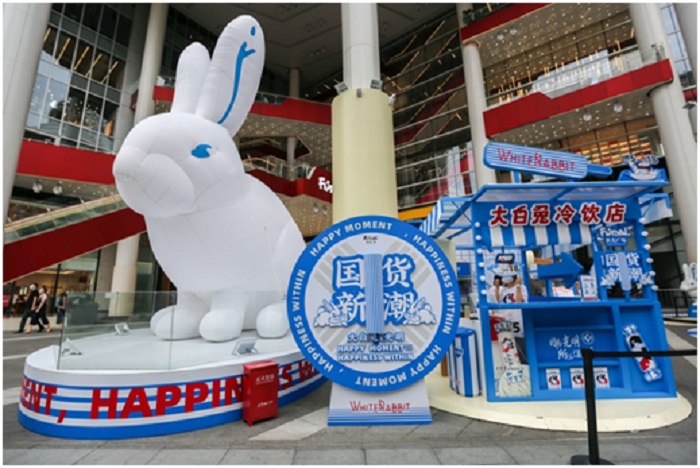
A pop-up shop is set up by White Rabbit, a Chinese candy brand with a nearly 70-year history on Nanjing Road, Shanghai, June 23. Photo by Wang Chu, People's Daily Online

China’s home-grown brands are gradually claiming an increasingly larger share of the country’s domestic consumption market as Chinese original designs are attracting more and more fans.
The reemerging time-honored brands of China, such as White Rabbit candies, Yashuang vanishing cream, and Warrior sneakers, which have accompanied generations of Chinese, are glowing again today with new vitality.
According to a recent report on Chinese brands, over 80 percent of products consumed by Chinese in 2019 were manufactured by domestic brands. Other data also indicated that 173 China’s home-grown brands reported sales volume of over 100 million yuan ($14.96 million) during last year’s “Double 11” online shopping festival, accounting for nearly 60 percent of the total. It reflected in part the strength of the Chinese domestic brands in the country’s consumption market, as well as their increasing influence.
A series of excellent China-designed products were recently displayed at an exhibition of “China chic” (a term refers to fashion trends native to China) launched by the People’s Daily New Media Center, including smart televisions that were able to interact with users and recognize dialects, Peking Opera-themed toothpastes with Chinese herbal ingredients, and garments that combined retro and modern elements. The exhibition not only attracted many young people, but also well explained the emergence of China’s home-grown brands during the past five years.
“Made in China” has constantly enhanced its quality and evolved toward intelligent manufacturing during the country’s 13th Five-Year Plan period (2016-2020). A few years ago, the news of Chinese consumers buying toilet covers, electric cookers and hair dryers from overseas once spammed the internet, which reminded the country a fact that Chinese consumers were paying more attention on products’ quality and brands as they embraced a better life. They need domestic products to be great rather than just being functional, durable and practical. When consumption is gradually becoming personalized and diversified, it is more important to ensure products’ quality and stimulate demand through innovation. That explains why China has been striving to carry out supply-side structural reform during the past five years to satisfy people’s ever-growing, constantly upgrading, and increasingly individualized material, cultural, ecological, and environmental needs.
Thanks to the upgrading of the country’s manufacturing sector, as well as the in-depth implementation of the Internet+ strategy, China’s home-grown brands have continuously improved their capability and quality of supply, winning broad recognition from consumers.
They used to focus on quantities, but now they care more about quality and user experience; they once relied on original equipment manufacturer (OEM) businesses, but now they started their own brands; they manufactured products after receiving orders, but now they are producing more customized goods and have a more precise understanding of the market.
Domestic brands are no more known only for their high cost performance, but become a leader in quality and trend. Apart from the advantages in production scale and cost, their popularity also come from the recognition of the consumers. The performance of domestic brands is a proof to the increasingly enhancing competitiveness of Chinese manufacturing, and reflects the favorable effects of supply-side structural reform.
If the changes of consumers’ demands have created new development space for Chinese brands, then the rising of these brands is also in turn shaping consumers’ aesthetic capability and their pursuit for culture. In recent years, Chinese elements have been a distinct character of the products designed by domestic brands. For instance, Chinese domestic cosmetics brand Pechoin and Tong Ren Tang, the largest producer of traditional Chinese medicine in China have incorporated trendy elements in the design of their classic products, winning recognition from the young Chinese. The new Chinese products are not only satisfying consumers’ increasingly diversified demands, but also further stimulating their cultural confidence. In this regard, the rise of Chinese brands concerns both economy and culture.
Today, China’s home-grown brands are standing at a new starting point, and the broad market of the country is also offering a vast platform for their innovative development. As long as they stay alert to the demand of the market, make innovation, produce products with higher standards, and dig into the cultural value, we have every reason to believe that Chinese domestic brands will win a larger market and help people achieve a better life.


 AKH-TRACADA demands Justice, protection for abused Abia child, commends police
Anti-Kidnapping, Human Trafficking, Child Abuse and.
 AKH-TRACADA rejects campaign to pressure U.S. to release Tinubu’s FBI records, wants court to decide
Anti-Kidnapping, Human Trafficking, Child Abuse and.
 Nigeria celebrates Chinese cuisines at food festival
Nigeria has celebrated Chinese cuisines of.
 2027: Elumelu Campaign Group sets to meet party executives, leaders
In a bid to strategize for.
 AKH-TRACADA congratulates Marwa on reappointment as NDLEA Chair
The Executive and members of the.
 Road Safety is a collective responsibility, says FCT DRTS Ag Director
The Acting Director, FCT Directorate of.
 Igbo group calls on Tinubu to release IPoB leader, Kanu
President Bola Ahmed Tinubu has been.
Ministerial slot: Tinubu appoints Nnaji’s replacementBarely a month after resignation of.
 Lawyer cautions Kanu against dragging Buratai into his trial
An Abuja based Legal Practitioner, Osuagwu.
Odey commends Tinubu for appointing Amupitan INEC chairConvener of Equitable Remedy, Mrs. Magaret.
Leave a Comment