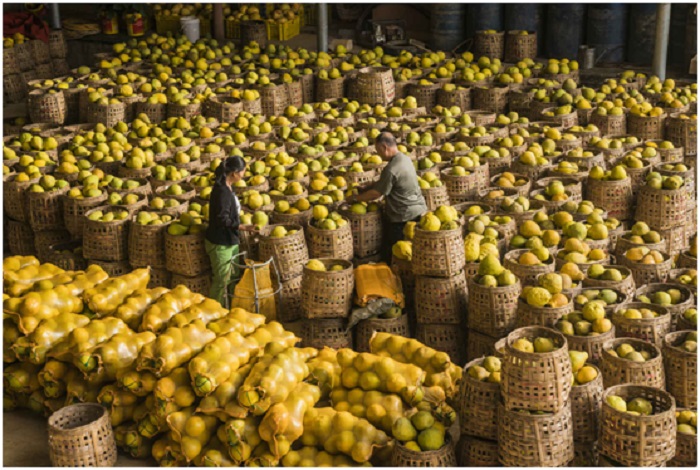
Villagers load baskets with grapefruits in a demonstration park for poverty alleviation in Baise, south China's Guangxi Zhuang autonomous region, Nov. 19. Photo by Liu Runchan/People's Daily Online

Developing local industries is currently a poverty reduction measure of China that covers the widest range, mobilizes the largest population and features the strongest sustainability.
The poverty alleviation policies aiming at supporting local industries have benefited 98 percent of China’s impoverished households, said Liu Huanxin, Vice Minister of Agriculture and Rural Affairs of China on a recent press conference.
According to him, the central government of China has spent over 40 percent of its funds for poverty reduction and rural development on developing local industries this year, and 680 billion yuan ($104 billion) of poverty alleviation microloans have been issued to help impoverished residents develop businesses.
China’s 832 impoverished counties have all made plans to eradicate poverty with industrial development, establishing over 300,000 industrial bases of planting, breeding and processing. Besides, new business forms such as tourism, photovoltaic power generation and e-commerce are also giving a leg up to poverty reduction. Every impoverished county has two to three characteristic industries that are able to mobilize a large number of impoverished households.
Over 13 million residents are currently working for rural enterprises and poverty alleviation workshops in their hometowns, accounting for nearly half of the impoverished employees. The per capita annual income of impoverished residents surged 30.2 percent from 3,416 yuan in 2015 to 9,808 yuan in 2019.
The rapid development of poverty relief industries facilitates the introduction of capital, technology and human resource to impoverished regions, and also accelerates the construction of transportation and logistics. According to statistics, China’s impoverished counties have built 210 million mu (14 million hectares) of high-standard farmland and 43,000 initial processing facilities for agricultural products, and fostered 14,400 leading enterprises at municipal level. They also established 719,000 agricultural cooperatives, 2,100 poverty reduction industrial parks, and 4,100 expert teams. Besides, over 4,000 agricultural technicians have been employed to further drive poverty eradication.
By fostering poverty relief industries, a series of effective modes have been established, and the impoverished residents are also inspired to chase a better life with their diligence, Liu said. Through make to order, land transfer, agricultural production trustee service, local employment, joint stock partnership and asset leasing, 72 percent of the impoverished households have established a close bond with new agricultural entities. More than 70 percent of the poor residents received guidance on production and technical training, and 900,000 entrepreneur leaders in different industries have been cultivated.


 2027: Elumelu Campaign Group sets to meet party executives, leaders
In a bid to strategize for.
 AKH-TRACADA congratulates Marwa on reappointment as NDLEA Chair
The Executive and members of the.
 Road Safety is a collective responsibility, says FCT DRTS Ag Director
The Acting Director, FCT Directorate of.
 Igbo group calls on Tinubu to release IPoB leader, Kanu
President Bola Ahmed Tinubu has been.
 Ministerial slot: Tinubu appoints Nnaji’s replacement
Barely a month after resignation of.
 Lawyer cautions Kanu against dragging Buratai into his trial
An Abuja based Legal Practitioner, Osuagwu.
Odey commends Tinubu for appointing Amupitan INEC chairConvener of Equitable Remedy, Mrs. Magaret.
 FCT waste disposal contractors notify of planned suspension of services over nine months debt
Contractors handling the contract for city.
 FG begins evacuation of stranded Nigerians in Central African Republic
Nigerian government may have concluded plans.
 DICAN hosts int’l conference, harps on global peace, security, dev’t
The Diplomatic Correspondents Association of Nigeria.
Leave a Comment