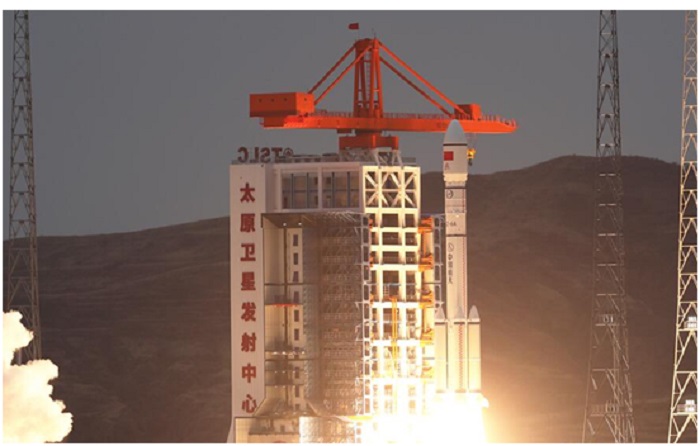
A modified version of the Long March-6 carrier rocket blasts off on March 29 from the Taiyuan Satellite Launch Center in North China's Shanxi province. (Photo from the China Aerospace Science and Technology Corporation)

A modified version of the Long March-6 carrier rocket with solid strap-on boosters blasted off from the Taiyuan Satellite Launch Center in north China’s Shanxi province at 5:50 p.m., March 29.
The rocket, on its maiden flight, sent two satellites, Pujiang 2 and Tiankun 2, into planned orbits. It was the 412th mission of the Long March rocket series.
The modified version is a new member of and further enriches China’s new-generation carrier rocket family. The launch also marked the first mission carried out at the Launch Area 9A of the Taiyuan Satellite Launch Center, China’s first intelligent launch area.
The modified version of the Long March-6 carrier rocket is about 50 meters in length. It can produce a lift-off thrust of 7,230 KN with a takeoff weight of about 530 tonnes. It’s capable of sending a payload of at least four tonnes to a sun-synchronous orbit at an altitude of 700 kilometers. The rocket is competitive both in its performance and cost.
As the first hybrid carrier rocket, the modified version of the Long March-6 gives full play to the advantages of liquid-fueled boosters – high performance and long working hours, as well as those of solid-fueled boosters, including high thrust, high reliability and easy maintenance. It will significantly enhance China’s capability in entering, exploiting and exploring space.
An expert noted that booster combinations of this carrier rocket can be diverse, thus meeting the needs of intensive launches of multiple types of satellites.
As the first intelligent launch area in China, the Launch Area 9A of the Taiyuan Satellite Launch Center gets rid of traditional models for launch missions. It can be left unattended four hours before a rocket blasts off, and all the operations are controlled remotely by an intelligent launch system, which largely improves launch efficiency, as well as the stability and safety of the launch command system.
The employment of the Launch Area 9A is of significant importance for further streamlining launch process, improving launch efficiency, and enhancing launch stability and safety. At the newly-built launch area, solid-fueled boosters can be directly installed and the launch area also enables rapid launches of the modified version of the Long March-6 carrier rocket with preparations of only 14 days. It will meet the highly frequent launch requirement to the medium and low orbit satellites.
It is learned that the Pujiang 2 satellite will complete scientific experiments and land resources surveys, and the Tiankun 2 is assigned with experiments on space environment detection technology.


 AKH-TRACADA rejects campaign to pressure U.S. to release Tinubu’s FBI records, wants court to decide
Anti-Kidnapping, Human Trafficking, Child Abuse and.
 Nigeria celebrates Chinese cuisines at food festival
Nigeria has celebrated Chinese cuisines of.
 2027: Elumelu Campaign Group sets to meet party executives, leaders
In a bid to strategize for.
 AKH-TRACADA congratulates Marwa on reappointment as NDLEA Chair
The Executive and members of the.
 Road Safety is a collective responsibility, says FCT DRTS Ag Director
The Acting Director, FCT Directorate of.
 Igbo group calls on Tinubu to release IPoB leader, Kanu
President Bola Ahmed Tinubu has been.
Ministerial slot: Tinubu appoints Nnaji’s replacementBarely a month after resignation of.
 Lawyer cautions Kanu against dragging Buratai into his trial
An Abuja based Legal Practitioner, Osuagwu.
Odey commends Tinubu for appointing Amupitan INEC chairConvener of Equitable Remedy, Mrs. Magaret.
 FCT waste disposal contractors notify of planned suspension of services over nine months debt
Contractors handling the contract for city.
Leave a Comment