

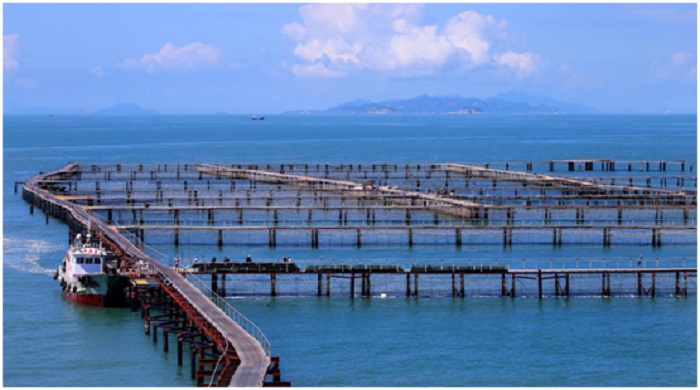
Many ports in China have recently entered the peak season of fishery production.
In Rongcheng, east China’s Shandong province, fishermen are putting out to sea and inshore aquatic farms getting busy. In Yuhuan of east China’s Zhejiang province, fishermen are loading ice onto their boats for refrigeration and patching fishing nets. In Hainan province, fish harvests are always seen at terminals.
The ocean, breeding lives and containing huge resources, plays a vital role. As a major maritime country, China boasts a long coastline, vast sea areas under national jurisdiction and abundant marine resources.
Since the ancient times, the Chinese people living in coastal areas have taken the sea as a source of fishing and salt making, as well as a means of transport. However, uncontrolled exploitation of resources would lead to overfishing, marine pollution and other problems.
To make a change, China has been constantly promoting the transformation and upgrading of traditional fishing businesses in recent years.
As the Chinese people gain deeper and deeper understanding of the sea, they have gradually reached a consensus that marine resources must be exploited in a reasonable manner. Therefore, they built a batch of marine ranching complexes that aim at restoring resources and developing eco-friendly mariculture with high quality and efficiency.
Aspiring to achieve harmony between humanity and the sea, these complexes not only conserve typical marine ecosystems, but also promote a transition of the fishery industry from a quantity-oriented model to a quality-oriented one. They have become a new area of growth for marine economy with their ability to drive the development of the fishery, leisure, tourism and culture sectors.
To develop marine ranching complexes is an important measure promoting the transformation and upgrading of the fishery industry. The complexes have embraced sustainable development thanks to sci-tech progress which enables fishermen to employ deep-sea net cages, aquaculture platforms and other techniques.
Huangwo village in Lianyungang, east China’s Jiangsu province once fell into poverty due to shrinking fishery resources. By establishing a mariculture cooperative and building a nori processing plant that turned fishermen into farmers, the village has embarked on a new path to prosperity.
Be it launching well-planned free-range farming of fish and crustaceans, or conducting deep-sea aquaculture, or developing leisure and tourism sub-industries, modern fishery not only brings more types of seafood to consumers, but also fosters more areas of growth for the marine economy.
The gradually maturing model of marine ranching complexes has not only broadened the space for fishery production, but also optimized the marine ecology in a subtle manner. For instance, the reduced frequency of inshore fishing nurtures fishery resources, and the decreasing stocking density in aquaculture is also helping the restoration of environment.
Practices prove that building a fish farming environment that benefits the breeding and growth of aquatic organisms will help promote the natural propagation and increase of aquatic biological resources and facilitate the improvement and restoration of the marine ecosystem. It is like building an “ecological bank” for the sea. Advancing ecological conservation while developing the fishery industry, these marine ranching complexes will help the fishery sector achieve both economic and ecological benefits.
As the only major fishery country in the world where aquaculture production exceeds the marine wild catch, China enjoys huge development potential in the fishery industry. It has an aquaculture sea area of over 1.2 million square kilometers.
The marine ranching complexes are taken as an important part of the construction of a modern marine industry system in China’s 14th Five-Year Plan (2021-2025) for National Economic and Social Development and the Long-Range Objectives Through Year 2035. In the future, the marine economy will embrace more important periods of development.
more recommended stories
2027: Elumelu Campaign Group sets to meet party executives, leadersIn a bid to strategize for.
AKH-TRACADA congratulates Marwa on reappointment as NDLEA ChairThe Executive and members of the.
Road Safety is a collective responsibility, says FCT DRTS Ag DirectorThe Acting Director, FCT Directorate of.
Igbo group calls on Tinubu to release IPoB leader, KanuPresident Bola Ahmed Tinubu has been.
Ministerial slot: Tinubu appoints Nnaji’s replacementBarely a month after resignation of.
Lawyer cautions Kanu against dragging Buratai into his trialAn Abuja based Legal Practitioner, Osuagwu.
Odey commends Tinubu for appointing Amupitan INEC chairConvener of Equitable Remedy, Mrs. Magaret.
FCT waste disposal contractors notify of planned suspension of services over nine months debtContractors handling the contract for city.
FG begins evacuation of stranded Nigerians in Central African RepublicNigerian government may have concluded plans.
DICAN hosts int’l conference, harps on global peace, security, dev’tThe Diplomatic Correspondents Association of Nigeria.


Leave a Comment