

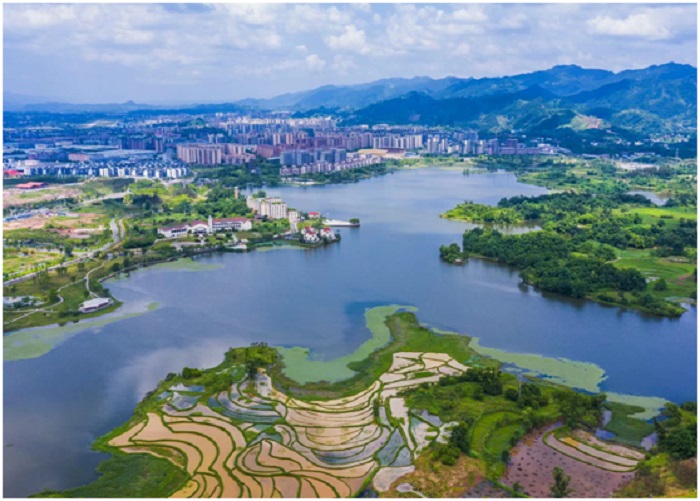
Lately, the second batch of 25 cities across the world was awarded Wetland City Accreditation, including seven Chinese cities, namely Hefei, Jining, Liangping, Nanchang, Panjin, Wuhan and Yancheng.
There are a total of 43 cities that hold the accreditation, among which 13 are in China, ranking the world’s first in number.
The accreditation representing a city’s ecological achievements, which is given by the intergovernmental environmental treaty Ramsar Convention, is a high and important honor worldwide for the protection of wetland ecology in cities.
The continuous increase in China’s city number of the accreditation indicates that wetland protection in the country has enjoyed standardized management and an awareness of wetland conservation has been gradually heightened in the whole Chinese society.
China now has 64 sites designed as “Wetlands of International Importance”, 602 wetland nature reserves, and more than 1,600 wetland parks.
As of the end of 2021, most wetlands in China had seen their water replenishment steadily increase, their overall water quality improve, and biodiversity enriched.
Since April 2017, the Ramsar Convention, also known as the Convention on Wetlands, has carried out the Wetland City Accreditation scheme around the world.
In July of that year, China issued interim measures for the nomination of candidate cities, which specified that the cities it nominates for the accreditation should not only have adequate wetland resources, but have taken comprehensive and stringent measures to protect wetlands and seen certain results.
Located in east China’s Shandong province, Jining, one of the Chinese cities newly added to the list, is rich in wetland resources, including riverine wetland and wetland in artificial lakes.
The city initiated a campaign aimed at the Ramsar’s Wetland City Accreditation in 2018. For the past several years, conservation and restoration of local wetlands have been given high priority and relevant facilities have been improved, earning much fame for the city.
More and more Chinese cities are making active efforts to apply for the accreditation.
Suzhou city in east China’s Jiangsu province has over 300 lakes including the well-known Taihu Lake and Yangcheng Lake, and more than 20,000 rivers including the Yangtze River. The total area of its natural wetlands has reached about 4 million mu (268,667 hectares), and the proportion of wetlands in the inland city ranks the first in the country.
Recently, Suzhou officially set in motion a campaign for the title, and strives to explore its unique model for the measures of wetland conservation.
The city has effectively strengthened its ecological restoration and environmental governance, and formed an eco-leisure tourism brand based on its characteristic ecological resources, fully reflecting the city’s ecological value.
Focusing on wetland protection, many cities have included their existing heritage sites in the conservation of wetland resources.
People began to redefine cultural and natural heritage projects from more perspectives, and put forward more comprehensive requirements for urban development.
Jining and Suzhou are both major heritage cities along China’s Grand Canal, a world-renowned artificial canal that has been inscribed on the World Heritage List of the United Nations Educational, Scientific, and Cultural Organization. The ancient canal has constantly explored water sources to guarantee water transport conditions.
Nansi Lake in Weishan county, Jining, includes four contiguous lakes, i.e. Weishan Lake, Zhaoyang Lake, Dushan Lake and Nanyang Lake, and is the largest lake in Shandong province.
The formation of the lake is closely related to the historical evolution of the Grand Canal. It is still an important channel of the canal, and is rich in natural resources, especially wetland resources.
In Jining’s application for the accreditation, the lake wetland, sites and sections along the Grand Canal recognized as world heritage, the Nansi Lake provincial nature reserve and 35 wetland parks above the municipal level together laid the foundation for Jining’s status as a Ramsar’s Wetland City.
These new features of natural environment and biodiversity presented by wetlands and wetland cities awarded have driven the combination of natural heritage elements with cultural heritage factors along the Grand Canal.
It not only adds new elements for experience in the Grand Canal national parks under construction, but also tests cities’ abilities and potential for coordinated development in the construction of ecological civilization.
more recommended stories
2027: Elumelu Campaign Group sets to meet party executives, leadersIn a bid to strategize for.
AKH-TRACADA congratulates Marwa on reappointment as NDLEA ChairThe Executive and members of the.
Road Safety is a collective responsibility, says FCT DRTS Ag DirectorThe Acting Director, FCT Directorate of.
Igbo group calls on Tinubu to release IPoB leader, KanuPresident Bola Ahmed Tinubu has been.
Ministerial slot: Tinubu appoints Nnaji’s replacementBarely a month after resignation of.
Lawyer cautions Kanu against dragging Buratai into his trialAn Abuja based Legal Practitioner, Osuagwu.
Odey commends Tinubu for appointing Amupitan INEC chairConvener of Equitable Remedy, Mrs. Magaret.
FCT waste disposal contractors notify of planned suspension of services over nine months debtContractors handling the contract for city.
FG begins evacuation of stranded Nigerians in Central African RepublicNigerian government may have concluded plans.
DICAN hosts int’l conference, harps on global peace, security, dev’tThe Diplomatic Correspondents Association of Nigeria.


Leave a Comment