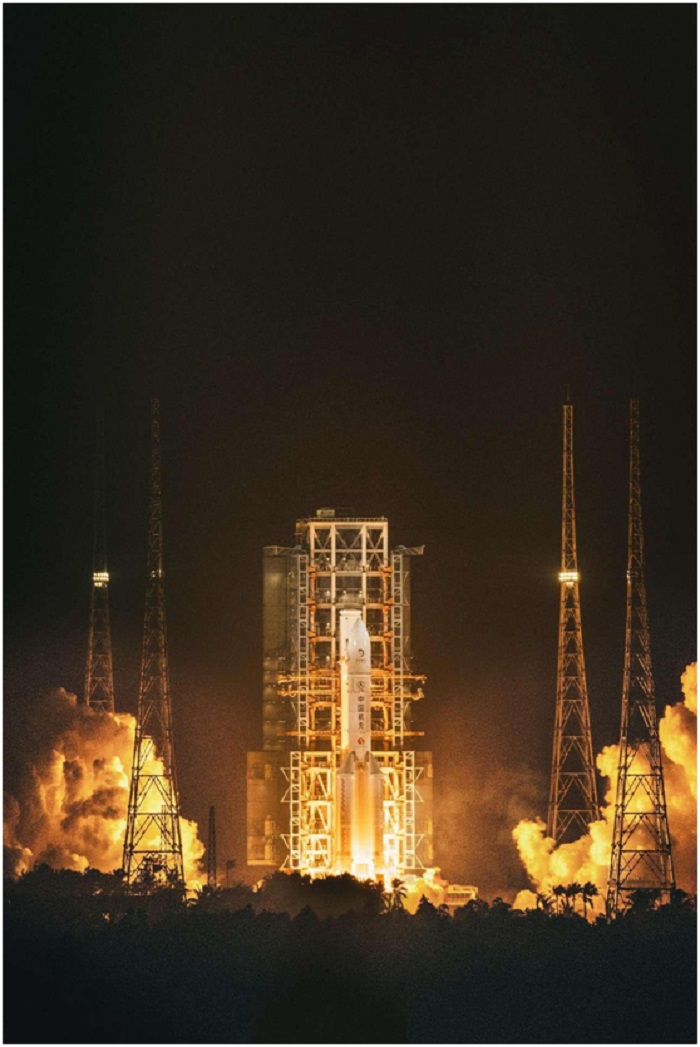
A Long March-5 rocket, carrying the Chang'e-5 spacecraft, blasts off from the Wenchang Spacecraft Launch Site on the coast of southern island province of Hainan, Nov 24, 2020. (Qiu Xinsheng/People's Daily Online)

Building on the glorious aerospace achievements made in the recent years, China still has a number of big moves to make in space in the coming years.
The fourth phase of the country’s lunar exploration program has been approved at the end of 2021 and entered implementation stage, said Wu Weiren, chief designer of China’s lunar exploration program.
The fourth phase of the program will be carried out in three steps, namely the Chang’e-6, -7, and -8 missions before 2030, according to Wu, who’s also an academician of the Chinese Academy of Engineering and a member of the Standing Committee of the National Committee of the Chinese People’s Political Consultative Conference (CPPCC), China’s top political advisory body.
The major goal of the phase-4 lunar program is to carry out scientific exploration at the lunar south pole in pursuit of building a basic structure of a lunar research station in the region, Wu introduced.
Speaking on the sidelines of the fifth session of the 13th National Committee of the CPPCC, he explained that China selects the lunar south pole as the location of the lunar research station because polar day/night phenomenon takes place in the north and south poles of the moon, just like it does on Earth. He said there may be more than 180 consecutive days of light on the moon’s south pole, which would ensure lasting scientific exploration activities.
Besides, scientists are also expecting to find traces of ice in the south pole of the moon. A special craft will fly from the landing site to a nearby crater for investigation and sampling, Wu said.
Landing in the lunar south pole would be challenging as the landing area there is only 1/10 of the size of that in the mid- and low-latitudes, Wu noted.
Chang’e-6 will attempt to retrieve samples from lunar pole regions and return them to earth, and Chang’e-7 will land on the lunar south pole to conduct scientific explorations and look for traces of ice. Chang’e-8, working in collaboration with Chang’e-7, will scout how to exploit lunar resources, carry out wide-range, full-scale and long-term observation of Earth, and verify key technologies to be applied in the construction of the lunar research station.
It is reported that Chang’e-6 and Chang’e-7 are expected to be launched around 2025.
Following Tianwen-1, China’s first mission to Mars conducted last year, the country will keep launching relevant missions such as Tianwen-2, Tianwen-3 and Tianwen-4, Wu disclosed.
Besides, the country will launch an asteroid probe during the 14th Five-Year Plan period (2021-2025) and strive to make breakthroughs in key technologies such as near-Earth asteroid sampling, Mars sample-return, and Jupiter exploration, the academician said.
According to him, China will also carry out feasibility studies on solar system margin exploration and other major projects.


 AKH-TRACADA rejects campaign to pressure U.S. to release Tinubu’s FBI records, wants court to decide
Anti-Kidnapping, Human Trafficking, Child Abuse and.
 Nigeria celebrates Chinese cuisines at food festival
Nigeria has celebrated Chinese cuisines of.
 2027: Elumelu Campaign Group sets to meet party executives, leaders
In a bid to strategize for.
 AKH-TRACADA congratulates Marwa on reappointment as NDLEA Chair
The Executive and members of the.
 Road Safety is a collective responsibility, says FCT DRTS Ag Director
The Acting Director, FCT Directorate of.
 Igbo group calls on Tinubu to release IPoB leader, Kanu
President Bola Ahmed Tinubu has been.
Ministerial slot: Tinubu appoints Nnaji’s replacementBarely a month after resignation of.
 Lawyer cautions Kanu against dragging Buratai into his trial
An Abuja based Legal Practitioner, Osuagwu.
Odey commends Tinubu for appointing Amupitan INEC chairConvener of Equitable Remedy, Mrs. Magaret.
 FCT waste disposal contractors notify of planned suspension of services over nine months debt
Contractors handling the contract for city.
Leave a Comment