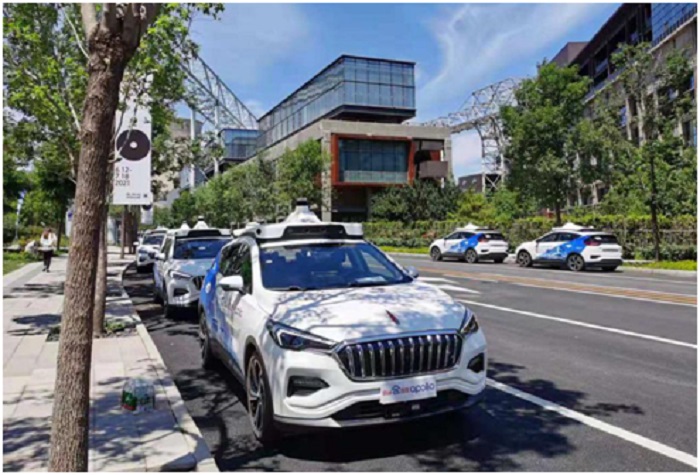
Photo shows autonomous vehicles of Chinese tech giant Baidu parked at the New Shougang High-end Industry Comprehensive Service Park in Beijing. (Photo by Du Yifei/People’s Daily)

In May, Changsha, capital city of central China’s Hunan province, put into trial operation its first smart commuter bus, which is connected via the Internet of Vehicles (IoV) to traffic lights at 26 crossings along the bus route from Yuelu district to High-Tech Industrial Development Zone of the city.
When the bus arrives at an intersection, the traffic light automatically turns green on the premise of safety, thus ensuring that it passes smoothly.
“Thanks to the bus, I can sleep half an hour longer before going to work,” said a resident surnamed Xing in Yuelu district.
Recently, China’s first batch of shared robotaxis, which are operated by Chinese tech giant Baidu, was officially launched in Beijing. Users can order robotaxi service through a mobile app.
These robotaxis are completely unmanned. Relevant information about the ride, such as the starting point, destination, and speed limit, is displayed on the screen in the vehicle, which is able to decide the route according to road conditions. Human intervention is not needed unless there is an emergency.
Intelligent transportation is the result of comprehensive application of information, communication, and sensing technologies to transportation.
Unlike the traditional way of improving transportation intelligence mainly through equipment integration, new-generation information technologies including AI and 5G are expected to promote the leapfrog development of intelligent transportation.
Equipped with advanced AI, radar and geographic information technologies, the “brain” of vehicles has evolved rapidly, which gives vehicles better “vision” and “intelligence quotient” that enable them to make decisions on their own, representing a great stride of driverless vehicles.
The rapidly developing 5G technology, which features low latency and wide connection, is considered a powerful tool for pushing ahead intelligent transportation. For example, it has guaranteed accurate, reliable, and extremely quick-response transmission signal for controlling subway trains running in autonomous driving mode.
In April, Shenzhen city, south China’s Guangdong province, put into operation its first 5G-based driverless subway line.
Various fields of transportation industry are making efforts to advance intelligent transportation, from optimizing the control of traffic lights to establishing a smart platform for urban transportation.
Smart transportation is at its start-up stage, and will soon embrace rapid growth, according to Nie Yuren, general director of the solution department of Baidu’s Intelligent Driving Group.
Despite the huge potential, intelligent transportation still has a long way to go in terms of large-scale application on the whole. Intelligent transportation cannot run well without a set of mutually supporting systems. The lack of any one single part of these systems may result in failure of the operation of the whole intelligent transportation system.
For example, the realization of high-level autonomous driving requires both “smart” vehicles and “smart” roads, which calls for the establishment of a vehicle-road collaboration network involving intelligent infrastructure, data-based decision-making and management systems.
Chinese government departments and transportation industry players are putting into efforts to improve the weak links of smart transportation. In May, relevant Chinese authorities stressed that the country would further promote the integration of single vehicle intelligence and IoV and speed up the industrialization of intelligent connected vehicles.
China’s faster new infrastructure construction will provide solid underpinning for the coordinated development of vehicles and roads, said Zhang Yaqin, chair professor at the Tsinghua University as well as head of the Institute for AI Industry Research under the university. Zhang believes the vehicle-road collaboration network will be continuously improved with progressing technical solutions.


 AKH-TRACADA rejects campaign to pressure U.S. to release Tinubu’s FBI records, wants court to decide
Anti-Kidnapping, Human Trafficking, Child Abuse and.
 Nigeria celebrates Chinese cuisines at food festival
Nigeria has celebrated Chinese cuisines of.
 2027: Elumelu Campaign Group sets to meet party executives, leaders
In a bid to strategize for.
 AKH-TRACADA congratulates Marwa on reappointment as NDLEA Chair
The Executive and members of the.
 Road Safety is a collective responsibility, says FCT DRTS Ag Director
The Acting Director, FCT Directorate of.
 Igbo group calls on Tinubu to release IPoB leader, Kanu
President Bola Ahmed Tinubu has been.
Ministerial slot: Tinubu appoints Nnaji’s replacementBarely a month after resignation of.
 Lawyer cautions Kanu against dragging Buratai into his trial
An Abuja based Legal Practitioner, Osuagwu.
Odey commends Tinubu for appointing Amupitan INEC chairConvener of Equitable Remedy, Mrs. Magaret.
 FCT waste disposal contractors notify of planned suspension of services over nine months debt
Contractors handling the contract for city.
Leave a Comment