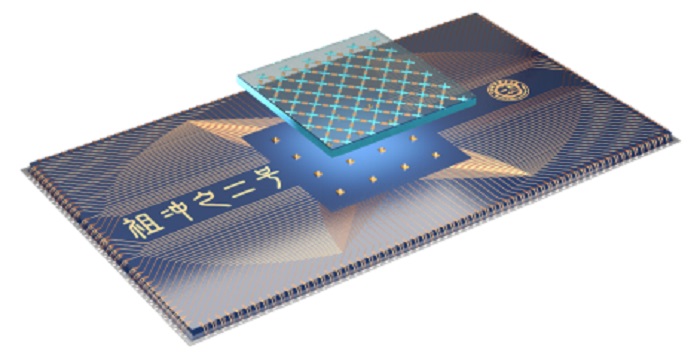
Photo shows the quantum processor "Zuchongzhi 2.1." (Photo from the official website of the University of Science and Technology of China)

Research teams from the University of Science and Technology of China (USTC) recently made marked progress in superconducting quantum computing and photonics quantum computing technology, developing a programmable superconducting quantum computing system named “Zuchongzhi 2.1” and a quantum computer prototype named “Jiuzhang 2.0.”
This made China the only country in the world today to have achieved quantum computational advantage in two mainstream technical routes.
The “Zuchongzhi 2.1,” a 66-qubit programmable superconducting quantum computing system, was developed by a USTC research team led by Pan Jianwei, Zhu Xiaobo and Peng Chengzhi and the Shanghai Institute of Technical Physics of the Chinese Academy of Sciences. It can perform large-scale random quantum circuits sampling about 10 million times faster than the fastest existing supercomputer.
The “Jiuzhang 2.0” can produce up to 113 photon detection events out of a 144-mode photonic circuit. It was developed by a USTC research team led by Pan Jianwei, Lu Chaoyang and Liu Naile, as well as the Shanghai Institute of Microsystem and Information Technology of the Chinese Academy of Sciences, and the National Research Centre of Parallel Computer Engineering & Technology. It is able to implement large-scale GBS septillion times faster than the world’s fastest supercomputer, marking a major step of China’s development of quantum computers.
Supercomputers are normally the type of computers with the strongest computing capabilities, fastest computing speed and largest storage. In 1981, Nobel Prize winner Richard Feynman came up with the idea to invent a new type of computer based on quantum technology. Quantum computing is considered a key technology for the next generation of information revolution.
Physical implementation of large-scale quantum computers is one of the major challenges for the world’s frontier technologies. Therefore, the international academic world is taking a three-step strategy for the physical implementation, and the first step is called quantum computational advantage.
At present, random circuit sampling based on superconducting qubits and GBS are two important solutions to demonstrate the quantum computational advantage, and the latest achievements are respectively the Zuchongzhi 2.1 and Jiuzhang 2.0.
The two supercomputers are each as large as a room, said Lu Chaoyang, professor with the USTC, adding that the two differ in medium. “Superconducting quantum computing relies on superconducting materials, and photonics quantum computing on photons,” he explained.
The successful demonstration of the quantum computational advantage marked the start of the second step of quantum computing studies.
“At present, we’re still at a very initial stage of quantum computing, and it’s too early to predict the prospects of the technology’s future application. But it can at least improve our computing capabilities and helps scientific research in a number of fields, such as drug design, molecular simulation and code breaking,” Lu said.


 AKH-TRACADA rejects campaign to pressure U.S. to release Tinubu’s FBI records, wants court to decide
Anti-Kidnapping, Human Trafficking, Child Abuse and.
 Nigeria celebrates Chinese cuisines at food festival
Nigeria has celebrated Chinese cuisines of.
 2027: Elumelu Campaign Group sets to meet party executives, leaders
In a bid to strategize for.
 AKH-TRACADA congratulates Marwa on reappointment as NDLEA Chair
The Executive and members of the.
 Road Safety is a collective responsibility, says FCT DRTS Ag Director
The Acting Director, FCT Directorate of.
 Igbo group calls on Tinubu to release IPoB leader, Kanu
President Bola Ahmed Tinubu has been.
Ministerial slot: Tinubu appoints Nnaji’s replacementBarely a month after resignation of.
 Lawyer cautions Kanu against dragging Buratai into his trial
An Abuja based Legal Practitioner, Osuagwu.
Odey commends Tinubu for appointing Amupitan INEC chairConvener of Equitable Remedy, Mrs. Magaret.
 FCT waste disposal contractors notify of planned suspension of services over nine months debt
Contractors handling the contract for city.
Leave a Comment