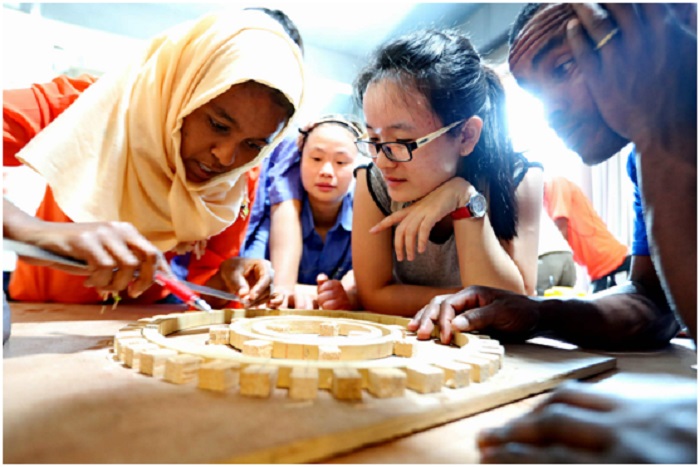
Ethiopian participants learn how to make a bamboo chandelier in Luzhou, southwest China’s Sichuan province, August 28, 2018. Photo by Yang Tao/People’s Daily Online

When the International Bamboo and Rattan Organisation, INBAR, was established back in 1997, by nine countries, we had a simple mandate: to promote the use of bamboo and rattan for sustainable development.
Bamboo and rattan are some of the most valuable non-timber forest products in the world. They’re fast growing, versatile and can support the livelihoods of millions of people, many of them in very poor rural communities. As we show at INBAR, bamboo and rattan are also important nature-based solutions for some of the key challenges facing our world, including land degradation, climate change, plastic pollution and biodiversity loss.
As an intergovernmental organization, made up mainly of developing countries from the Global South, INBAR provides an important network for sharing technologies and experiences related to bamboo and rattan use. In the past 23 years, our work has generated hundreds of thousands of jobs and contributed to the formation of national and international standards and policies regarding bamboo and rattan.
China now boasts the world’s biggest bamboo and rattan sector, and exports a huge range of products around the world. China is also one of the most innovative bamboo and rattan economies. In my time as Director General of INBAR, I have visited factories which are using these plants to produce everything from flooring and furniture to paper and plastic alternatives. I have even seen wind turbine blades and composite pressure pipes made from bamboo!
The secret to this success is strong support at a national and local level. China was one of the first countries to create a national bamboo strategy, and to prioritize the production of bamboo and rattan as more sustainable alternatives for timber.
In China, since the 1980s, government and private sector investments in the bamboo sector have resulted in a huge increase in jobs – from 1981 to 2016, the annual value of the bamboo sector increased from just $160 million to $35 billion. This has led to the generation of millions of formal jobs in the bamboo sector across the south of the country, bringing many people out of poverty. In fact, Chinese President Xi Jinping made his famous comment, “Lucid waters and lush mountains are invaluable assets”, in Anji, which is a key bamboo county in Zhejiang province.
Chishui, a forested mountainous area of Guizhou, is part of a UNESCO heritage site. Residents are taking up bamboo weaving and crafts instead of traditional forms of livelihood like mining or logging. Chishui is a great example of how bamboo can support “ecological civilization”.
In recent years, we have seen more and more international interest in the concept of “nature-based solutions”: protecting and restoring natural systems which can also support humans in various ways. Actually, China has already been saying this for more than a decade, when it talks about “ecological civilization”.
China is taking a leading role in promoting “nature-based solutions” for climate change and sustainable development. It is the host of the next UN conference on biodiversity in Kunming, and helped establish the “Nature-Based Solutions Coalition” with New Zealand at the UN Climate Summit in 2019. The International Horticultural Exhibition 2019, Beijing, China last year was a great example of China’s focus on green development.
China’s policy with regard to poverty alleviation is a good example to the entire world, especially developing countries. A lot of our training programmes include a visit to China, where beneficiaries can see the bamboo and rattan sector up close, and be inspired by some of the work being done.
Bamboo and rattan are ubiquitous resources across the Global South. They connect some of the most remote rural communities around the world, from the Asia-Pacific to Africa, Latin America and the Caribbean. They really are ideal materials for South-South cooperation. Through INBAR’s work, countries as far apart as Colombia and Nepal are sharing knowledge about earthquake-resistant bamboo housing, and a bamboo charcoal kiln design first created in India is now being replicated across countries in East Africa.
As with many things, this year COVID-19 has unfortunately interrupted the flow of training participants to China. COVID-19 is a very big challenge for many countries, and will have negative impacts on economic growth and poverty reduction around the world. However, COVID-19 also makes it more important than ever for humans to reflect on our relationship with the environment. At INBAR, we believe that bamboo and rattan can be important tools to help China, and the world, build a greener, fairer society.


 2027: Elumelu Campaign Group sets to meet party executives, leaders
In a bid to strategize for.
 AKH-TRACADA congratulates Marwa on reappointment as NDLEA Chair
The Executive and members of the.
 Road Safety is a collective responsibility, says FCT DRTS Ag Director
The Acting Director, FCT Directorate of.
 Igbo group calls on Tinubu to release IPoB leader, Kanu
President Bola Ahmed Tinubu has been.
 Ministerial slot: Tinubu appoints Nnaji’s replacement
Barely a month after resignation of.
 Lawyer cautions Kanu against dragging Buratai into his trial
An Abuja based Legal Practitioner, Osuagwu.
Odey commends Tinubu for appointing Amupitan INEC chairConvener of Equitable Remedy, Mrs. Magaret.
 FCT waste disposal contractors notify of planned suspension of services over nine months debt
Contractors handling the contract for city.
 FG begins evacuation of stranded Nigerians in Central African Republic
Nigerian government may have concluded plans.
 DICAN hosts int’l conference, harps on global peace, security, dev’t
The Diplomatic Correspondents Association of Nigeria.
Leave a Comment