
President Bola Ahmed Tinubu

Nigerian government has reiterated its commitment of making national security a top priority by adopting a comprehensive approach combining military strength, intelligence, diplomacy and community engagement.
While briefing Members of the Diplomatic Corps on behalf of Nigerian Foreign Minister in Abuja Wednesday, Permanent Secretary of Nigerian Foreign Ministry, Amb. Dunoma Umar Ahmed said the sustained operations such as operation Hadin Kai and Operation Lake Sanity have degraded Boko Haram and ISWAP, reclaimed vast territories and facilitated the return of millions of displaced persons.
According to Ahmed, “National security remains a top priority for President Bola Tinubu administration which has adopted a comprehensive approach combining military strength, intelligence, diplomacy and community engagement.
“Sustained operations such as Operation Hadin Kai and Operation Lake Sanity have degraded Boko Haram and ISWAP, reclaimed vast territories and facilitated the return of millions of displaced persons” he said.
Ahmed informed stated that advanced surveillance technologies were being deployed to combat banditry and kidnapping, while community-based peacebuilding and the National Early Warning and Response System (NEWS) enhance conflict prevention.
He informed that Civil-military cooperation had strengthened trust, improved intelligence gathering, and reduced the recruitment of extremists.
Speaking on Religious Diversity and Democratic Resilience, he said that Nigeria remains a global exemplar of religious plurality and democratic endurance, noting that 1999 Constitution guarantees complete freedom of thought, conscience, and religion and prohibits the adoption of any state religion.
He said Nigerian state was secular in both structure and function; policies and institutions operate without religious bias, ensuring that Christians and Muslims hold leadership positions across all levels.
Ahmed said the recent external claims suggesting systemic religious persecution in Nigeria were unfounded.
“The recent designation of Nigeria as a Country of Particular Concern (CPC) based on speculations of religious persecution is fundamentally misinformed. It misrepresents Nigeria’s secular constitutional order and its record in protecting religious freedom.
“Nigeria’s demographic balance, approximately equal Christian and Muslim populations, its interwoven communities, and its functioning multi-religious democracy stand as clear evidence of our coexistence.
“Nigeria’s judiciary has consistently demonstrated its independence, protecting freedom of expression and religion. The state continues to wage a comprehensive counter-terrorism campaign against groups that target Nigerians of all faiths. It is therefore inaccurate to characterize Nigeria’s complex security challenges as manifestations of state-sanctioned religious intolerance” he said.
While dismissing the blasphemy and persecution narrative, Ahmed said that Nigeria’s national legal framework contains no offence of blasphemy, stressing that the existing public-order laws are religion-neutral and protect all communities equally from incitement to violence.
“Sharia laws, limited to some northern states, apply only to Muslims and remain under the oversight of the secular judiciary. Christian and Muslim institutions operate freely, promoting peaceful coexistence. Interfaith harmony is sustained through institutions such as the Nigeria Inter-Religious Council (NREC), the Christian Association of Nigeria (CAN) and the Supreme Council for Islamic Affairs (NSCIA)” he stated.


 AKH-TRACADA opposes Sowore’s call to legalize cannabis
A Non-Governmental Organisation (NGO), Anti-Kidnapping, Human.
 3000 delegates from 126 countries to attend 2026 Abuja WPRF event – NIPR President
About 3000 delegates from 126 nations.
 FG, experts unite to tackle malnutrition with new National Plan
Nigeria has drawn a bold line.
 Tuggar makes case for Africa’s authentic owned, culturally grounded democracy
Nigerian Foreign Minister has stressed the.
 AKH-TRACADA commends Cross River Govt for creating Anti-Drug Club in schools
Anti – kidnapping, Human Trafficking, Child.
 China, Africa intelligentsia share thoughts on harnessing GGI potentials
Chinese and African intelligentsia have shared.
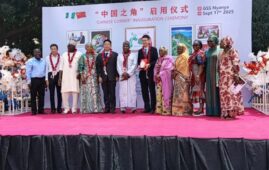 Establishment of 15 Chinese Corners highlights China, Nigeria relations – Education Secretary
FCT Mandate Secretary for Education, Dr..
 Chinese Mandarin officially added to Nigerian school curriculum
Nigerian government has formally added the.
 Climate Change: Tinubu calls for resilient, green inclusive industrial future
Nigerian President, Bola Ahmed Tinubu has.
AKH-TRACADA commiserates with Republic of Ghana over death of two ministers, other top officialsThe Anti – kidnapping, Human Trafficking,.
Leave a Comment