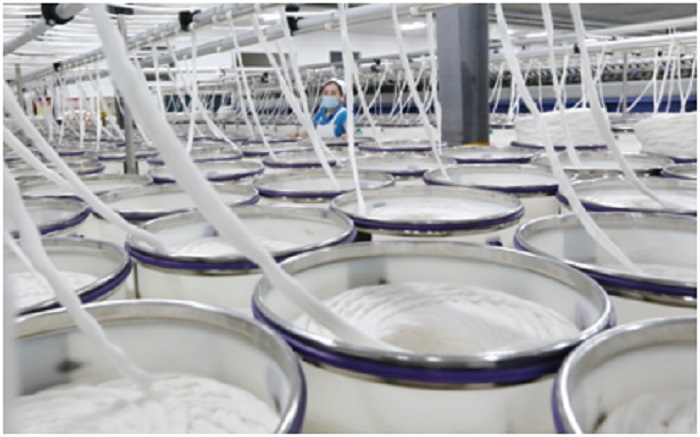
Worker works at a textile factory in Renshou county, Southwest China’s Sichuan Province on September 22. Photo by Yao Yongliang/People’s Daily Online

With China and 14 other economies signing the Regional Comprehensive Economic Partnership (RCEP), the world’s largest free trade agreement, on Sunday, the textile and apparel business will get a strong boost and form a more closely integrated supply chain in the Asia-Pacific region.
China’s textile industry will reap rising benefits because the nation has the most complete industry chains in the world, Chen Jing, vice president of the Technology and Strategy Research Institute, told the Global Times on Monday.
“Cooperation in textiles between China and the emerging economies in Southeast Asia has been profound. For instance, China has been exporting textile products and textile intermediate products to Vietnam for years. The reduced tariffs on these products will benefit Chinese spinners,” Chen noted.
The textile and apparel industry is a crucial sector benefitting from the RCEP deal, and it has long been a critical business among countries in the region. In 2015, the RCEP member countries exported $4.5 billion of textile and apparel products, accounting for more than half of the world’s total.
Textile mills in Southeast Asian countries will also benefit from the RCEP, thanks to the distinct pattern in the regional supply chain in the sector, Chen said.
“The elimination of higher trade barriers such as tariffs and investment barriers enabled by the RCEP agreement will strengthen Southeast Asia’s textile industry, with more flowing of China’s investment there,” he said, noting the RCEP will enlarge China’s role as the primary textile supplier in the industry chain, and make Southeast Asian countries better apparel producers.
More than 80 percent of textiles imported by members of the Association of Southeast Asian Nations (ASEAN) came from RCEP members in 2015 in terms of value, and around 81 percent of apparel imports by ASEAN were also from RCEP members, according to the World Trade Organization.
In recent years, a number of Chinese textile factories have shifted to offshore their manufacturing to Southeast Asian countries as labor costs is relatively low there.
Some of the industry’s major clients, including prominent international clothing brands, prefer contractors with plants in places with the cheapest labor to ensure their businesses’ competitiveness, Jin Xiaobo, CEO of Zhejiang Kaierhai Textile Garments Co, told the Global Times on Monday. But sometimes it is difficult to seek experienced workers.
“I went to some Southeast Asian countries and Bangladesh two years ago but didn’t end up establishing any factories,” Jin said. “The labor was cheap but there were not enough experienced workers. Now, we are thinking of putting it back on the agenda.”
Jin said that textile companies with business ties in ASEAN are ecstatic over the RCEP, but the final decision to offshore operations will depend on tariff cuts and whether the cost of training local staff can be offset by lower labor cost there.
More than 85 percent of the company’s business is for export, Jin said, and most of it goes to countries in Southeast Asia, including Malaysia, which takes 40 percent.
“Southeast Asia represents an extremely important market for our apparel business, which has been steadily rebounding since June,” Jin said. “We will definitely think about setting up more offices and plants in the region when finer details of the preferential policies from the RCEP are out.”
Source: Global Times


 2027: Elumelu Campaign Group sets to meet party executives, leaders
In a bid to strategize for.
 AKH-TRACADA congratulates Marwa on reappointment as NDLEA Chair
The Executive and members of the.
 Road Safety is a collective responsibility, says FCT DRTS Ag Director
The Acting Director, FCT Directorate of.
 Igbo group calls on Tinubu to release IPoB leader, Kanu
President Bola Ahmed Tinubu has been.
 Ministerial slot: Tinubu appoints Nnaji’s replacement
Barely a month after resignation of.
 Lawyer cautions Kanu against dragging Buratai into his trial
An Abuja based Legal Practitioner, Osuagwu.
Odey commends Tinubu for appointing Amupitan INEC chairConvener of Equitable Remedy, Mrs. Magaret.
 FCT waste disposal contractors notify of planned suspension of services over nine months debt
Contractors handling the contract for city.
 FG begins evacuation of stranded Nigerians in Central African Republic
Nigerian government may have concluded plans.
 DICAN hosts int’l conference, harps on global peace, security, dev’t
The Diplomatic Correspondents Association of Nigeria.
Leave a Comment