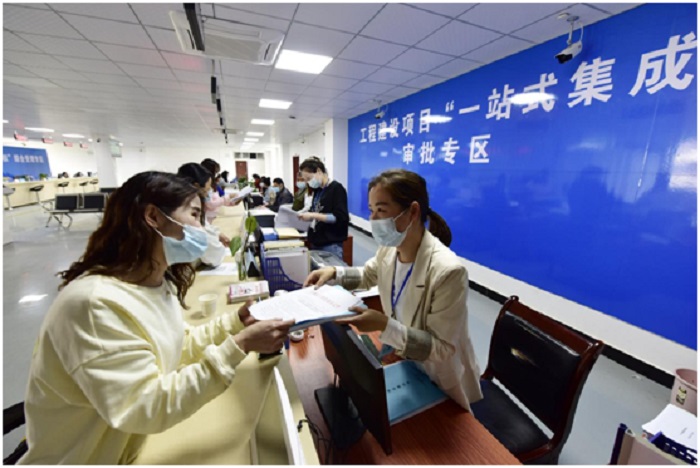
Photo taken on April 15, 2022 shows people applying for engineering construction approvals at a one-stop service center in Ningdu county, Ganzhou, east China’s Jiangxi province. (Photo by Zeng Rongfeng/People’s Daily Online)

China’s continuous efforts to deepen its reforms to streamline administration, delegate power, improve regulation and upgrade services for building a world-class business environment have greatly vitalized market entities and made important contributions to promoting high-quality economic and social development.
So far, the number of market entities across the country has exceeded 150 million, with an average annual increase of more than 12 percent. The number of private enterprises in the country increased fourfold in the past decade.
As of the end of 2020, the time needed for starting a company in China had been reduced to less than four workdays, down from 22.9 since the country kicked off its national business system reform in 2014.
“It used to take six months for us to get a business license, but now we can get it in just one workday the soonest possible,” said Phyllis Cheung, CEO of McDonald’s China.
Cheung explained that in the past, her company had to apply for a series of certificates when opening a new restaurant, such as business license, food business license, organization code certificate, tax registration certificate, social insurance registration certificate, and pollutants discharge license.
According to Cheung, some of the certificates have merged into one today and some have been canceled, which significantly saves time for enterprises.
While streamlining approvals, China is also working to improve its management. It launched the National Enterprise Credit Information Publicity System in 2017, which strengthens supervision on delegated matters when they are being handled and after they have been handled.
As of March this year, more than 700 entities had been listed as enterprises with serious illegal and dishonest acts by market regulation authorities across the country, and their information has been disclosed on the system.
Besides, China is constantly enhancing its services for enterprises by optimizing business procedures. In the past, if an enterprise made a mistake when filling an application form, then it had to go to the department in charge again and refill the form. Today, thanks to e-government services, enterprises can apply for certificates online.
So far, 31 provincial-level regions in China have electronized business registration procedures since the country piloted a national electronized registration program in 2016.
According to Zhou Hui, who runs a private vocational school in Changzhou, east China’s Jiangsu province, it took him about one and a half months to apply for a permit for running private vocational schools in the past, but the same application only takes a day nowadays.
“The survival and development of market entities rely on business environment. Great environment makes great enterprises. Relevant departments across China, upholding the vision that business environment means productivity, have constantly optimized business environment with multifaceted measures, which has continuously stimulated the passion of market entities for investment,” said Liu Quanhong, director of the International Economics Research Institute of the Chinese Academy of Macroeconomic Research.
To cope with the impacts of COVID-19 on some market entities, a new version of the new regulation on market entity registration unveiled last year allows market entities with management difficulty to register for suspension, which has provided a “buffer zone” for these entities.
“The business suspension rule is quite considerate and helps enterprises lower cost. It is lending a hand to us,” said Wu Jieping, owner of a tech firm based in Shenzhen, south China’s Guangdong province.
According to a plan advancing the modernization of China’s market regulation over the 14th Five-Year Plan period (2021-2025), the country will improve its market regulation system and efficiency eying on the general market, quality and supervision. It will promote the modernization of market regulation, strive to build an international business environment that is market-oriented and law-based, and vitalize the market.
An official with the State Administration for Market Regulation told People’s Daily that the department will further advance pilot programs on improving the business environment and make the market entry and exit mechanism more open, transparent, standard and efficient, so as to set more examples in business environment building and better serve the high-quality economic and social development of the country.


 2027: Elumelu Campaign Group sets to meet party executives, leaders
In a bid to strategize for.
 AKH-TRACADA congratulates Marwa on reappointment as NDLEA Chair
The Executive and members of the.
 Road Safety is a collective responsibility, says FCT DRTS Ag Director
The Acting Director, FCT Directorate of.
 Igbo group calls on Tinubu to release IPoB leader, Kanu
President Bola Ahmed Tinubu has been.
 Ministerial slot: Tinubu appoints Nnaji’s replacement
Barely a month after resignation of.
 Lawyer cautions Kanu against dragging Buratai into his trial
An Abuja based Legal Practitioner, Osuagwu.
Odey commends Tinubu for appointing Amupitan INEC chairConvener of Equitable Remedy, Mrs. Magaret.
 FCT waste disposal contractors notify of planned suspension of services over nine months debt
Contractors handling the contract for city.
 FG begins evacuation of stranded Nigerians in Central African Republic
Nigerian government may have concluded plans.
 DICAN hosts int’l conference, harps on global peace, security, dev’t
The Diplomatic Correspondents Association of Nigeria.
Leave a Comment