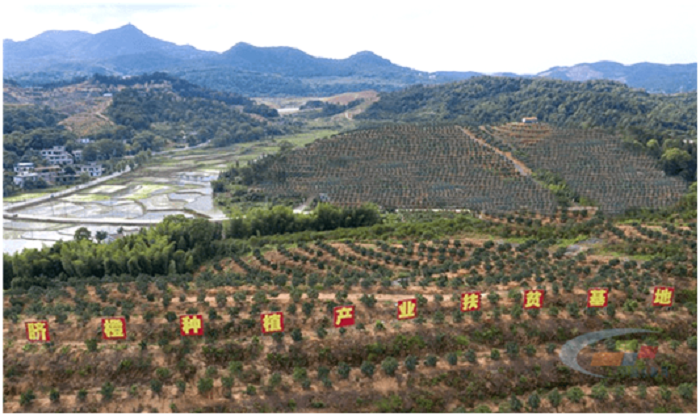
Photo shows a navel orange plantation in Shitang village, Yuannan township, Luxi county, Pingxiang, east China's Jiangxi province. (Photo courtesy of the poverty alleviation office of Jiangxi province)

“Why does the earth look like coal?” That’s a frequently asked question by many that pass by Peng Huiyun’s navel orange orchard.
“Because it is coal.” That’s what Peng always answers.
Peng’s orchard, located in Shitang village, Yuannan township, Luxi county, Pingxiang, east China’s Jiangxi province, was once a coal mine, which was a source of income for around 90 percent of the villagers in the 1990s, including Peng.
A 2009 national survey of forest resources found that over 90,000 mu, or 6,000 hectares of abandoned mines in Pingxiang needed to be ecologically restored. As the idea of “lucid waters and lush mountains are invaluable assets” gradually took root in the hearts of the Chinese people, the abandoned mines grabbed the attention of the cadres in Pingxiang, who were expecting that the ecological restoration could attract social capital to develop local industries.
“We were planning to contract barren mountains, and an official with the local forestry department told us that there were abandoned mines here,” said Wei Yuanzhong, an executive of an eco-farming company in Jiangxi.
By that time, Peng had already quit his mining job for a long time and was serving as the director of the village committee. The message from the company hoping to contract the mines surprised him very much.
Wei later planted navel oranges on the mines. Despite the fact that it seemed impossible, he was quite confident about it. After professional determination of the composition of the soil on the mines, Wei’s company found that the soil underneath the coal gangue was still fertile. Therefore, the company flattened the ground, applied fertilizers, and buried straws under the soil to improve its fertility. In the second year, navel oranges were planted there.
Instead of clearing away the coal gangue, Peng just left it there and flattened the ground, because the soil was not polluted by the coal gangue. That’s why the earth in his orchard is black. The orchard is projected to yeild 25,000 kilograms of navel oranges this year, according to him.
Now, Wei’s company has contracted 3,000 mu of abandoned mines in Pingxiang, and the local government of Yuannan township has bought into the company with financial funds. A total of 294 households that have just been lifted out of poverty can receive annual bonus.
So far, Pingxiang has invested nearly 400 million yuan from the state and provincial revenue in greening abandoned coal mines, and over 2/3 of the 90,000 mu of abandoned mines in the city have been ecologically restored.


 2027: Elumelu Campaign Group sets to meet party executives, leaders
In a bid to strategize for.
 AKH-TRACADA congratulates Marwa on reappointment as NDLEA Chair
The Executive and members of the.
 Road Safety is a collective responsibility, says FCT DRTS Ag Director
The Acting Director, FCT Directorate of.
 Igbo group calls on Tinubu to release IPoB leader, Kanu
President Bola Ahmed Tinubu has been.
 Ministerial slot: Tinubu appoints Nnaji’s replacement
Barely a month after resignation of.
 Lawyer cautions Kanu against dragging Buratai into his trial
An Abuja based Legal Practitioner, Osuagwu.
Odey commends Tinubu for appointing Amupitan INEC chairConvener of Equitable Remedy, Mrs. Magaret.
 FCT waste disposal contractors notify of planned suspension of services over nine months debt
Contractors handling the contract for city.
 FG begins evacuation of stranded Nigerians in Central African Republic
Nigerian government may have concluded plans.
 DICAN hosts int’l conference, harps on global peace, security, dev’t
The Diplomatic Correspondents Association of Nigeria.
Leave a Comment