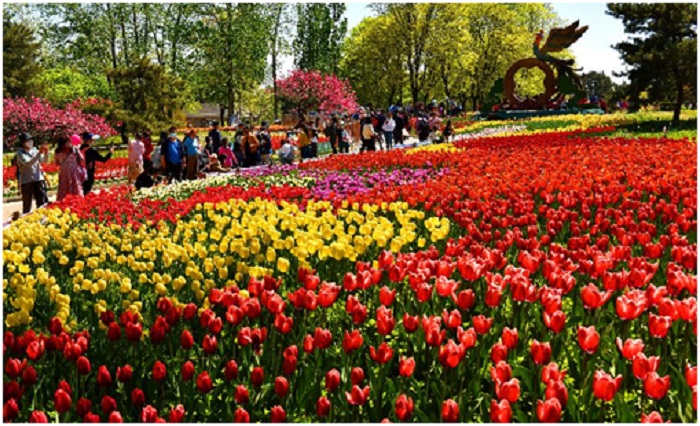
Visitors appreciate over 200,000 tulips of over 100 species at the Beijing Botanical Garden, April 18, 2021. (Photo by Li Wenming/People’s Daily Online)

China’s State Council recently approved a plan to establish a national botanical garden in Beijing, ushering in a new stage of the country’s endeavor to set up a national botanical garden system.
As one of the countries with the richest plant diversity in the world, China is home to more than 36,000 species of higher plants.
Botanical gardens are the primary sites for ex-situ conservation of endangered plant species. China has nearly 200 botanical gardens where over 23,000 plant species, or 60 percent of the country’s indigenous plant species, are under ex-situ conservation. For a long time, botanical gardens have played a positive role in maintaining plant diversity.
Why the national botanical garden chooses to be built in Beijing? Top scientists and researchers and high-end scientific research platforms are essential precondition for the most efficient ex-situ conservation of plant diversity in China, according to Long Chunlin, a professor at the Minzu University of China and former chief engineer at the Germplasm Bank of Wild Species in Southwest China.
The national botanical garden to be established in Beijing has a planned area of nearly 600 hectares and will be built on two sites. By expanding and improving the existing Beijing Botanical Garden, the country aims to make the new botanical garden a world-class national botanical garden with Chinese characteristics.
According to an official with China’s National Forestry and Grassland Administration (NFGA), the southern part of the national botanical garden, which will be constructed based on existing resources from the Institute of Botany of the Chinese Academy of Sciences (IBCAS), will focus on scientific research and experiment, with an emphasis on basic scientific research for plants, biodiversity conservation, as well as the research and development (R&D) of core technologies for plant resource utilization.
The northern part of the garden will be built relying on relevant authorities in Beijing. This part of the garden will mainly perform functions including ex-situ collection, science popularization and display, and serve endeavors such as plant application research, conservation and cultivation of rare and endangered plants, collection and display of horticultural plants, as well as research and training in horticultural techniques.
With 15,000 plant species under ex-situ protection, the new national botanical garden will be the only botanical garden in China that has the globally-recognized three greenhouse flagship species.
It will also be equipped with the strongest plant scientific research team at home, and boast two state-level key laboratories, three key laboratories of the Chinese Academy of Sciences (CAS), one municipal-level key laboratory of Beijing as well as the largest herbarium in Asia which houses more than 2.8 million specimens. The national botanical garden is expected to become an internationally renowned comprehensive plant scientific research institution.
Beijing enjoys geographical advantages for building the national botanical garden. As the capital city of China, the city has a suitable climate and many wetlands. Temperate, subtropical and even tropical plants, cold- and drought-resistant plants, wetland plants can all grow here, said Li Junqing, a professor at the School of Ecology and Nature Conservation, Beijing Forestry University.
IBCAS offers outstanding plant scientific research teams and the national botanical garden built based on the south and north parks of the Beijing Botanical Garden can serve as a center for scientific research, science popularization and education as well as exhibition and display, Li added.
China is gathering pace in building a natural reserve system centered on national parks, taking important steps toward promoting the in-situ conservation of wild plants.
A plant ex-situ conservation network guided by the national botanical garden system will supplement the in-situ conservation system, thus effectively achieving full coverage of plant diversity conservation and its sustainable utilization in China.
The NFGA has initiated the planning for China’s national botanical garden system, aiming to steadily advancing the construction of the system region by region. It will gradually achieve the goal of ensuring ex-situ conservation of more than 85 percent of China’s wild native plants and all wild plant species under key protection.


 2027: Elumelu Campaign Group sets to meet party executives, leaders
In a bid to strategize for.
 AKH-TRACADA congratulates Marwa on reappointment as NDLEA Chair
The Executive and members of the.
 Road Safety is a collective responsibility, says FCT DRTS Ag Director
The Acting Director, FCT Directorate of.
 Igbo group calls on Tinubu to release IPoB leader, Kanu
President Bola Ahmed Tinubu has been.
 Ministerial slot: Tinubu appoints Nnaji’s replacement
Barely a month after resignation of.
 Lawyer cautions Kanu against dragging Buratai into his trial
An Abuja based Legal Practitioner, Osuagwu.
Odey commends Tinubu for appointing Amupitan INEC chairConvener of Equitable Remedy, Mrs. Magaret.
 FCT waste disposal contractors notify of planned suspension of services over nine months debt
Contractors handling the contract for city.
 FG begins evacuation of stranded Nigerians in Central African Republic
Nigerian government may have concluded plans.
 DICAN hosts int’l conference, harps on global peace, security, dev’t
The Diplomatic Correspondents Association of Nigeria.
Leave a Comment