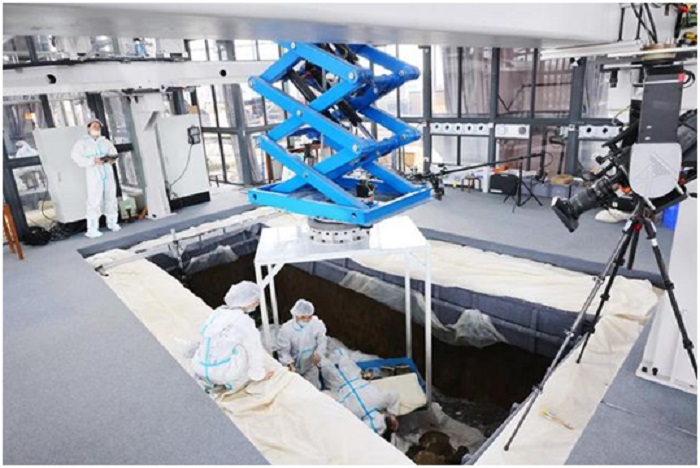
Photo shows an on-site archaeological workshop established at the excavation site of Sanxingdui, southwest China's Sichuan province. (Photo courtesy of the Sichuan Provincial Cultural Relics and Archaeology Research Institute)

Shovels, brushes and tape measures are probably what one could think of when it comes to the tools of archaeologists. However, it’s not a difficult thing to see modern technologies being applied in China’s archaeological tasks nowadays.
At the site of archaeological excavation for Wanjiao One, an ancient Chinese merchant ship that sank off the coast of Pingtan county, southeast China’s Fujian province, archaeologists were equipped with full-face rebreathers that put them on wireless communication with their colleagues both under and above the water.
In the aquarium that houses the Nanhai No. 1 shipwreck, discovered 25 meters under the South China Sea in 1987 and salvaged 20 years later, remote sensing platforms can obtain data at millimeter level in a contactless, multi-angle and smart manner.
Besides, at the Sanxingdui archaeological site in southwest China’s Sichuan province, on-site workshops have been built to better preserve cultural relics.
The application of modern technologies has enriched the philosophy, methods and content of archaeology. It is also making archaeological missions safer, more precise, and more effective, broadening and deepening China’s archaeology cause to an unprecedented extent.
The excavations of Sanxingdui have been carried out under the support of multiple disciplines, which mirrors the integration of modern technologies and archaeology. At the excavation site, there are many transparent glass houses that are designed to protect unearthed cultural relics. The temperature and humidity in these houses are fixed, and trusses and lifters are there to move the relics and for archaeologists to clean the relics in a contactless manner.
China’s modern archaeology raised its curtain as relics were unearthed in the excavation of the Yangshao site in Chisheng county, central China’s Henan province a hundred years ago.
Today, remote sensing, as well as digital and smart technologies are widely applied in archaeological investigations, and new methods are being promoted one after another, such as 3D printing, aerial photography drones and DNA analysis. Be it under the earth or in the water, technologies are playing an increasingly important role in archaeological surveying, excavation, restoration, preservation, and researches.
To trace the origins of cultural relics and civilizations and represent the glorious history is a special mission of archaeology. Today, with radiocarbon dating, we know ages of cultural relics, and with lead isotope geochemistry, we know origins of them. The broad and in-depth sci-tech application is enlarging the space of archaeological studies.
Cultural relics are history in a perceptible form. To enhance people’s understanding of history and their respect for civilizations with cultural relics is an important part of the preservation and inheritance of cultural relics.
For instance, the launch of the Digital Dunhuang resource database enables people around the world to enjoy the magnificent views of the Dunhuang Mogao Grottoes with just clicks on their mouse, and a mini-program introducing the cultural heritage has so far received nearly 40 million visits.
Besides, in Fuzhou Museum, Fujian province, a motion sensing system is launched to simulate an underwater archaeological site, so that visitors can have better experiences.
Digital technologies are constantly changing the ways of how cultural relics are displayed, making people’s cultural life more splendid and offering a strong support for the protection of cultural relics.


 2027: Elumelu Campaign Group sets to meet party executives, leaders
In a bid to strategize for.
 AKH-TRACADA congratulates Marwa on reappointment as NDLEA Chair
The Executive and members of the.
 Road Safety is a collective responsibility, says FCT DRTS Ag Director
The Acting Director, FCT Directorate of.
 Igbo group calls on Tinubu to release IPoB leader, Kanu
President Bola Ahmed Tinubu has been.
 Ministerial slot: Tinubu appoints Nnaji’s replacement
Barely a month after resignation of.
 Lawyer cautions Kanu against dragging Buratai into his trial
An Abuja based Legal Practitioner, Osuagwu.
Odey commends Tinubu for appointing Amupitan INEC chairConvener of Equitable Remedy, Mrs. Magaret.
 FCT waste disposal contractors notify of planned suspension of services over nine months debt
Contractors handling the contract for city.
 FG begins evacuation of stranded Nigerians in Central African Republic
Nigerian government may have concluded plans.
 DICAN hosts int’l conference, harps on global peace, security, dev’t
The Diplomatic Correspondents Association of Nigeria.
Leave a Comment