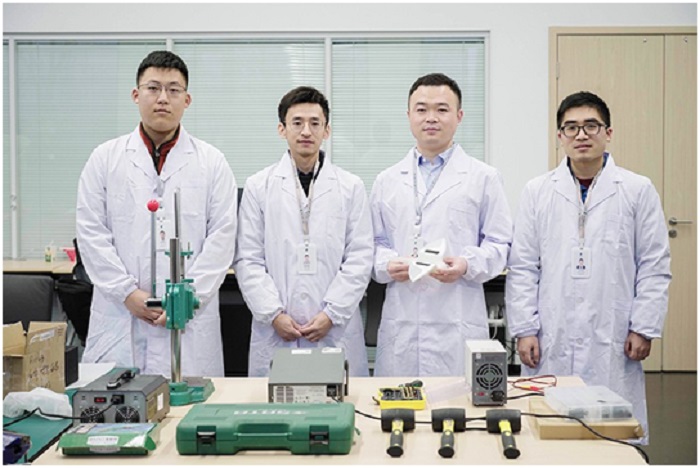
The research team of the self-powered deep-sea soft robot in the Mariana Trench (Photo/official website of the Zhejiang Lab)

A latest achievement made by a joint research team from China’s Zhejiang Lab (ZJ Lab) and Zhejiang University (ZJU) was published on Nature as a cover story titled “Self-powered Soft Robot in the Mariana Trench” on March 4.
The research team created the world’s first soft robot that can be operated 10,000 meters under the ocean surface and completed the world’s first deep-sea free-swimming test of a soft robot.
The Mariana Trench, the deepest known point in Earth’s oceans, is called the “fourth pole of the Earth” for its high hydrostatic pressure, low temperature and complete darkness.
The continuous advancing progress of deep diving technologies enabled people to have found hundreds of animal species in the hadal zones of the Mariana Trench, including the snailfish, an animal that is able to survive a pressure of nearly 100 MPa thanks to its structure – bones distributed in tiny parts in its soft gelatinous body.
Inspired by the unique structure of the snailfish, the research center for intelligent robot of the ZJ Lab and the center for X-mechanics of the ZJU kicked off a research into deep-sea soft robot in May 2018.
The self-powered soft robot developed by the joint research team is in the shape of a fish, with a length of 22 cm and a wingspan of 28 cm, approximately as large as A4 sheets.
Hard components, including control circuits and batteries, are distributed across the gel-like body of the robot. The materials and structure of components and the robot body enable the robot to resist hydrostatic pressure 10,000 meters under the ocean surface without any hard shell.
In summary, a machinery system fusing hard and soft components and is able to resist deep-sea hydrostatic pressure, as well as a new dielectric elastomer actuator that works in high-pressure and cold deep-sea environment, are the two major breakthroughs that make the robot a success.
“Compared with traditional high pressure-resistant deep diving equipment, the deep-sea soft robot was developed with brand new technologies, which is expected to significantly reduce the difficulty and cost of deep-sea exploration,” said Li Guorui, the first author of the article, as well as a senior researcher with the research center for intelligent robot of the ZJ Lab.
In December 2019, the robot performed steady wing-flapping movement at a depth of 10,900 meters in the Mariana Trench. Around nine months later, it successfully completed free swimming at a depth of 3,224 meters in the South China Sea.
“Our robot enjoys bright application prospects in harsh and extreme environments such as deep sea, polar regions, and high-impact scenarios,” Li noted.
The research team will continue studying the integrated system of energy, drive, and perception of deep-sea soft robots, so as to improve their intelligence while cutting application costs.
“We also plan to apply key technologies of the soft robot to deep-sea vehicles, and develop small deep-sea equipment with functions of deep-sea communication and detection,” said Liang Yiming, the second author of the research.


 2027: Elumelu Campaign Group sets to meet party executives, leaders
In a bid to strategize for.
 AKH-TRACADA congratulates Marwa on reappointment as NDLEA Chair
The Executive and members of the.
 Road Safety is a collective responsibility, says FCT DRTS Ag Director
The Acting Director, FCT Directorate of.
 Igbo group calls on Tinubu to release IPoB leader, Kanu
President Bola Ahmed Tinubu has been.
 Ministerial slot: Tinubu appoints Nnaji’s replacement
Barely a month after resignation of.
 Lawyer cautions Kanu against dragging Buratai into his trial
An Abuja based Legal Practitioner, Osuagwu.
Odey commends Tinubu for appointing Amupitan INEC chairConvener of Equitable Remedy, Mrs. Magaret.
 FCT waste disposal contractors notify of planned suspension of services over nine months debt
Contractors handling the contract for city.
 FG begins evacuation of stranded Nigerians in Central African Republic
Nigerian government may have concluded plans.
 DICAN hosts int’l conference, harps on global peace, security, dev’t
The Diplomatic Correspondents Association of Nigeria.
Leave a Comment