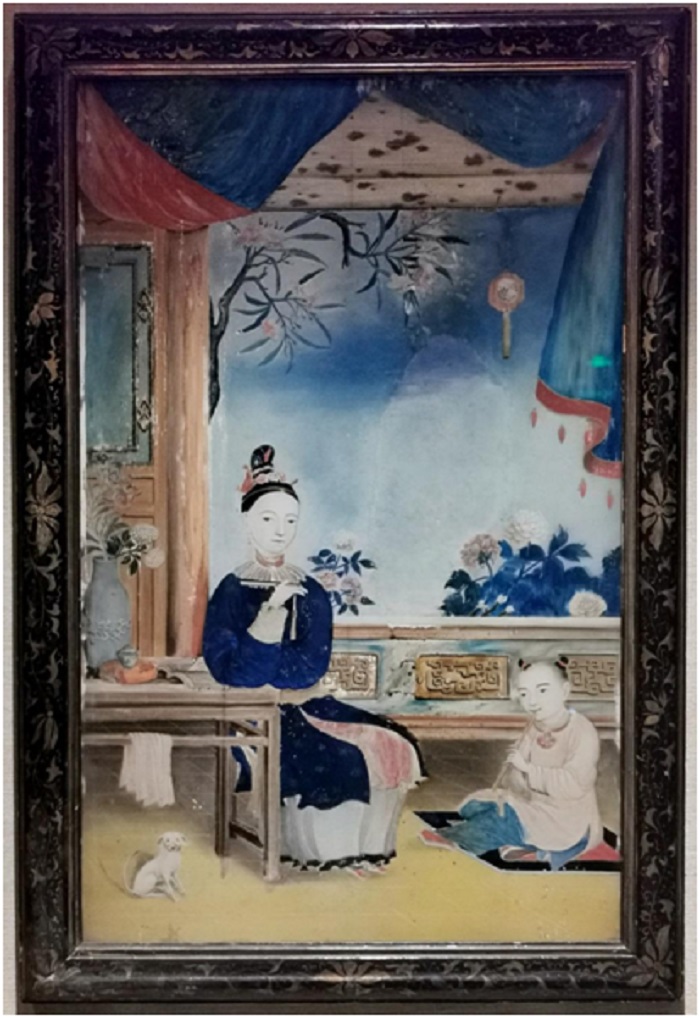
Photo shows a glass painting exhibited in the Thirteen Hongs Museum in Guangzhou, south China’s Guangdong province. (Photo by Luo Xun/People’s Daily)

Thirteen Hongs Museum, a thematic history museum located in Guangzhou Cultural Park, also the site of a business area consisting of thirteen hongs, or large trading houses, in China’s Qing Dynasty (1644-1911), has brought people closer to the history of foreign trade in Guangzhou, capital city of south China’s Guangdong province.
Over 2,000 years ago, Guangzhou was an important stop along China’s ancient Maritime Silk Road. From the year 1757 to 1842, the thirteen hongs served as a special zone approved by the court of the Qing Dynasty for trade with European countries and the U.S., and have been of great significance for the economic and cultural exchanges between China and foreign countries.
Established in 2016, the Thirteen Hongs Museum aims to showcase the evolution of the thirteen hongs with a large amount of historical documents and cultural relics from both home and abroad.
The first floor of the museum is set up with a permanent exhibition, which mainly displays the history of Guangzhou as a major trade port with European countries and the U.S. in the Qing Dynasty through historical documents and materials.
A grand mural painting in the center of the first floor presents a magnificent scene of boats of the thirteen large trading houses gathering at the trade port of Guangzhou, while a big bowl conspicuously put in the middle of the exhibition hall gives out warm tones under the light.
The big bowl glazed using a unique technique of Guangzhou is the first cultural relic the museum has collected after its establishment, according to Li Li, an exhibition planner with the Thirteen Hongs Museum.
It was a souvenir specially ordered by a foreign merchant ship to commemorate its voyage to Guangzhou, Li added.
The inside of the bowl is printed with the reign tile of the year 1757, which signifies the ties of the bowl and the thirteen hongs, Li pointed out.
Li has participated directly in the construction and operation of the museum, and has rich knowledge of the exhibits in the museum as well as the history of the thirteen hongs.
From 1757 to 1842, Guangzhou was designated as the only foreign trade port by the court of the Qing Dynasty, Li noted, adding that during the period, the city dominated China’s trade with foreign countries, thus driving the rapid development of the thirteen hongs.
Each exhibit represents a period of history. The 4,700 pieces (sets) of collections in the museum have mirrored the culture of the ancient Maritime Silk Road, the values, spirits and culture passed down for generations in the Lingnan region (including Guangdong) as well as the cultural exchanges between China and the Western countries.
Besides the a permanent exhibition on the first floor, the museum showcases in a special room on the second floor all the donations from Wang Heng and his wife, Feng Jie, which comprise a large proportion of the collections in the museum.
“Over 100 years ago, the goods from the thirteen hongs were loaded onto boats and then taken to countries around the world from here. Now we need to find them and bring them back to the museum,” said Wang, who was also recognized as an honorary director of the museum.
Wang believes that the thirteen hongs is not only a part of Guangzhou’s history, but also a calling card of the city. He thinks it necessary for Guangzhou citizens to learn about the history of the thirteen hongs.
The collections in the museum have been increasing with each passing day. All of them came from donors like the Wongs.
To effectively protect cultural relics not only requires vigorous support and strict supervision from the government and relevant departments, but also the participation of social forces, Li noted.
While enriching collections, the museum has also engaged in academic research in recent years. It has promoted a lot of research on the thirteen hongs, the ancient Maritime Silk Road as well as specially glazed porcelain of Guangzhou.


 2027: Elumelu Campaign Group sets to meet party executives, leaders
In a bid to strategize for.
 AKH-TRACADA congratulates Marwa on reappointment as NDLEA Chair
The Executive and members of the.
 Road Safety is a collective responsibility, says FCT DRTS Ag Director
The Acting Director, FCT Directorate of.
 Igbo group calls on Tinubu to release IPoB leader, Kanu
President Bola Ahmed Tinubu has been.
 Ministerial slot: Tinubu appoints Nnaji’s replacement
Barely a month after resignation of.
 Lawyer cautions Kanu against dragging Buratai into his trial
An Abuja based Legal Practitioner, Osuagwu.
Odey commends Tinubu for appointing Amupitan INEC chairConvener of Equitable Remedy, Mrs. Magaret.
 FCT waste disposal contractors notify of planned suspension of services over nine months debt
Contractors handling the contract for city.
 FG begins evacuation of stranded Nigerians in Central African Republic
Nigerian government may have concluded plans.
 DICAN hosts int’l conference, harps on global peace, security, dev’t
The Diplomatic Correspondents Association of Nigeria.
Leave a Comment