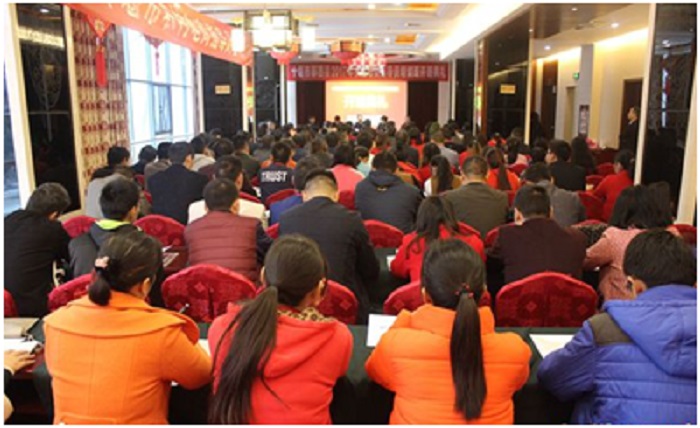
Local government hosts a training session about e-commerce for local residents in Yunxi county, Central China’s Hubei Province. Photo: Official website of Yunxi Government

Guo Mingfeng’s online shop received orders worth 50,000 yuan (about $7,639) in one night during this year’s Double 11 online shopping festival from Nov. 1 to 11.
The 51-year-old was once an impoverished resident of Xiaying village, Yunxi county, Shiyan city in Central China’s Hubei Province. In 2015, she started learning how to run an online store from other villagers, despite not knowing anything about computers.
In recent years, her store’s annual sales volume has exceeded 300,000 yuan, as she advertises his products via WeChat, an instant messaging app in China, and live-streaming sessions.
“Being almost illiterate, I basically use the voice chat function on WeChat to communicate with customers. I benefit a lot from live-streaming, as I’m blessed with the gift of the gab,” Guo said, laughing.
Guo’s success can also be attributed to Xiaying’s determination to develop e-commerce. Located deep in the mountains and isolated from the outside world, it was one of 84 major poor-stricken villages in Yunxi county, which is one of the 14 contiguous impoverished areas in China.
By 2014, there were 617 impoverished people from 179 households out of the total 339 households in the village, a poverty headcount rate of more than 40 percent.
Relying on its local calaite resources and making efforts to reduce poverty through e-commerce, Xiaying became Hubei’s most famous Taobao village, a title granted by Chinese e-commerce giant Alibaba to villages that see total annual e-commerce transactions of over 10 million yuan.
Xiaying shook off poverty in 2017. So far, about 700 people from 139 households in the village have become directly engaged in e-commerce, said Liu Tingzhou, Party chief of the village, adding that Xiaying’s total sales of products exceeded 200 million yuan in 2019.
The village has also built a center for poverty alleviation through e-commerce, ensured 5G coverage, and attracted over 10 express delivery companies.
At the center, local influencer Jiang Chunli and her husband Huang Hai have established a live-streaming team made up of 12 members, with a daily sales volume of about 100,000 yuan.
Villagers also host live-streaming shows in their Western-style buildings. Jiang Lijun, who is in his fifties, holds live-streaming sessions in his living room every day, generating an annual sales revenue of over 1 million yuan.
Wang Huajian and his wife sell tea through their online shop and live-streaming sessions, generating an annual revenue of more than 10 million yuan, encouraging over 450 nearby households to plant tea trees.


 2027: Elumelu Campaign Group sets to meet party executives, leaders
In a bid to strategize for.
 AKH-TRACADA congratulates Marwa on reappointment as NDLEA Chair
The Executive and members of the.
 Road Safety is a collective responsibility, says FCT DRTS Ag Director
The Acting Director, FCT Directorate of.
 Igbo group calls on Tinubu to release IPoB leader, Kanu
President Bola Ahmed Tinubu has been.
 Ministerial slot: Tinubu appoints Nnaji’s replacement
Barely a month after resignation of.
 Lawyer cautions Kanu against dragging Buratai into his trial
An Abuja based Legal Practitioner, Osuagwu.
Odey commends Tinubu for appointing Amupitan INEC chairConvener of Equitable Remedy, Mrs. Magaret.
 FCT waste disposal contractors notify of planned suspension of services over nine months debt
Contractors handling the contract for city.
 FG begins evacuation of stranded Nigerians in Central African Republic
Nigerian government may have concluded plans.
 DICAN hosts int’l conference, harps on global peace, security, dev’t
The Diplomatic Correspondents Association of Nigeria.
Leave a Comment