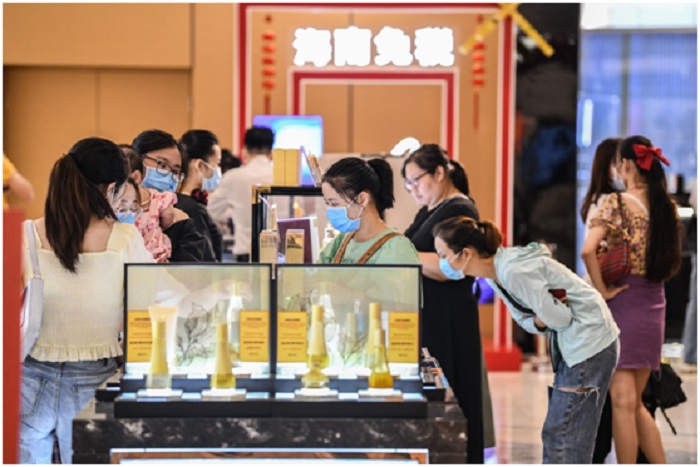
Customers shop at a duty-free store of the Riyue Plaza, Haikou, South China’s island province Hainan on July 30. Photo by Wang Chenglong/People’s Daily Online

The World Bank issued a special report entitled China’s Doing Business Success: Drivers of Reform and Opportunities for the Future on July 27.
According to the report, China has made great achievements in advancing reforms to delegate power, streamline administration and optimize government services as well as in improving the business environment.
The report has summarized the reforms China has carried out in recent years in fields such as “starting a business”, “getting electricity” and “dealing with construction permits”, in a bid to share lessons learned from China’s experience in improving the business environment with other economies and then improve the global business environment on the whole.
Taking the assessment of the World Bank on the business environment of global economies as an leverage, China has strived to create a stable, fair, transparent and predictable business environment in recent years.
China’s ranking in the world in terms of ease of doing business has continuously rocketed up, according to the World Bank’s Doing Business reports. China leaped from the 78th place in Doing Business 2018 to the 31st in 2020 and was recognized as one of the top 10 most improved economies worldwide for the ease of doing business for two years in a row.
Before 2018, only around two to three reforms in China were captured by Doing Business each year. However, Doing Business 2019 recorded seven areas of reforms for China while Doing Business 2020 captured reforms in eight areas.
The number of China’s business reforms recognized by Doing Business ranks among the top three in the world and the country has become the top reformer among large economies.
The World Bank attributed China’s successful reforms to six key factors, including high-level leadership and ownership of the reform agenda, local policy experimentation, international knowledge sharing, strong enforcement of the reform agenda and accountability for results, robust private sector participation and effective communication, as well as intensive use of digital technologies and e-government services.
Provinces and government departments in China have always comprehensively implemented the decisions and plans of the Central Committee of the Communist Party of China (CPC) and the State Council comprehensively and advanced reforms to delegate power, streamline administration and optimize government services.
By cutting the drawbacks of institutional mechanisms and strengthening services and regulation, China has maximumly reduced its direct allocation of resources and direct intervention in market activities, and greatly stimulated market vitality and social creativity.
For instance, Jiangsu Province allows residents and enterprises to have their matters dealt with through online platforms; Zhejiang’s provincial government aims to ensure that things requiring presence in person get done in one place and without the need for a second trip; and Shanghai encourages the government to serve the enterprises wholeheartedly and suit their demands.
During the first half of 2020, exports of private enterprises increased by 3.2 percent, 6.2 percentage points higher than the growth of China’s general export, which mirrored the better business environment in the country.
Against the backdrop of an ever-changing international environment and rampant anti-globalization and trade protectionism, the Chinese government has always advocated globalization and promoted opening-up to an even higher level.
It has made continuous efforts to relax controls over and shorten negative list for market access, held large-scale trade fairs and expositions, created a fair market environment, and protected the legitimate rights and interests of foreign investors and intellectual property rights, which has boosted the long-term confidence of foreign companies in China.
Data from the Ministry of Commerce suggested that the actual use of foreign capital increased by 8.4 percent year on year during the second quarter of the year.
China determines to build a world-class business environment. It has officially put into force the Foreign Investment Law and its implementation regulations and repeatedly shortened negative list for market access.
It is also speeding up in revising the Catalogue of Encouraged Industries for Foreign Investment for 2020 and the Working Measures for Complaints from Foreign Invested Enterprises.
Recently, the State Council Information Office has hosted a press briefing where relevant government officials introduced a circular about further optimizing the business environment and better serving market entities.
The international economic and financial practitioners are generally optimistic about China’s economic performance and long-term development, including American business people who praised a series of measures related to reform and opening-up adopted by the Chinese government and expressed wishes to continue exploring the Chinese market.
Despite the severe challenges brought about by the COVID-19 epidemic, China has been promoting the resumption of work, production, business and market, gradually restoring the economy and society to normal order.
China’s economy grew by 3.2 percent in the second quarter, making it the first major economy to achieve positive economic growth amid the epidemic and laying a solid foundation for the country to sustain economic recovery in the second half of the year.
To carry out the vision of innovative, coordinated, green, open and inclusive development, promote high-quality economic growth, ensure stability in employment, financial operations, foreign trade, foreign investment, domestic investment, and expectations, and ensure security in job, basic living needs, operations of market entities, food and energy security, stable industrial and supply chains, and the normal functioning of primary-level governments, China will continue streamlining administration and delegating powers to establish a world-class business environment based on market principles and the rule of law.
It will provide high-quality public services and a fair environment for domestic and foreign-funded enterprises and companies of various types of ownership, further stimulate the vitality of market players, strengthen new driving forces for development, and promote a higher level of opening-up.
China will surely create new opportunities for the development of all countries with a more open mind and inject strong impetus into the international economic growth.


 AKH-TRACADA demands Justice, protection for abused Abia child, commends police
Anti-Kidnapping, Human Trafficking, Child Abuse and.
 AKH-TRACADA rejects campaign to pressure U.S. to release Tinubu’s FBI records, wants court to decide
Anti-Kidnapping, Human Trafficking, Child Abuse and.
 Nigeria celebrates Chinese cuisines at food festival
Nigeria has celebrated Chinese cuisines of.
 2027: Elumelu Campaign Group sets to meet party executives, leaders
In a bid to strategize for.
 AKH-TRACADA congratulates Marwa on reappointment as NDLEA Chair
The Executive and members of the.
 Road Safety is a collective responsibility, says FCT DRTS Ag Director
The Acting Director, FCT Directorate of.
 Igbo group calls on Tinubu to release IPoB leader, Kanu
President Bola Ahmed Tinubu has been.
Ministerial slot: Tinubu appoints Nnaji’s replacementBarely a month after resignation of.
 Lawyer cautions Kanu against dragging Buratai into his trial
An Abuja based Legal Practitioner, Osuagwu.
Odey commends Tinubu for appointing Amupitan INEC chairConvener of Equitable Remedy, Mrs. Magaret.
Leave a Comment